
How to Care for Malabar Parrots
Last updated: October 2026
Prepared by the Birdsville team, who have raised Malabar Parrots by hand in our Alexandria store.
With its dove-grey head, blue wings and long blue tail, the Malabar Parrot (also called the Malabar Parakeet or Blue-winged Parakeet) is one of the most distinctive parakeets in aviculture. It comes from the forests of southern India and is rarely kept in Australia, so good care information is hard to find. We’ve put this malabar parrot care guide together at Birdsville, the Alexandria bird store (684 Botany Road, Alexandria NSW 2015) that has served Sydney bird keepers for over 40 years and blends its own Birdsville Blends (https://birdsville.net.au/birdsville-blends/) seed. This guide covers feeding, housing, worming, mite control, training and health.
Looking after a Malabar Parrot comes down to a roomy cage or aviary for its long tail, a tropical parrot seed mix with daily fresh food, regular worming and mite control, and calm, patient handling. A well cared for Malabar Parrot can live 15 to 25 years.
Malabar Parrot Key Takeaways
Malabar Parrots are rare in Australian aviculture and need an experienced, patient owner.
A Malabar Parrot diet should be built on Birdsville Blends Tropical Small Parrot or Tropical Large Parrot seed, plus fresh greens, fruit and some pellets.
Malabar Parrots should be wormed every 6 months once settled, but not straight after weaning, while their gut bacteria are still developing.
Lice and mites are the parasites Malabar Parrots pick up most often, and a regular spray keeps them under control.
Male Malabar Parrots have a red upper beak and a blue-green band under the black collar, while females have an all-black beak.
Malabar Parrots should never share an aviary with ringnecks or other Asiatic parrots, because they can hybridise.
Malabar Parrots grow to about 38cm long, mostly tail, and live around 15 to 25 years in captivity.
Malabar Parrots usually lay 3 to 5 eggs, which the hen incubates alone for about three weeks.
The Malabar Parrot is listed as Least Concern, but it’s a restricted-range species found only in India’s Western Ghats, and trade in wild birds is illegal in India.
Everything a Malabar Parrot needs, from seed to mite spray, can be ordered through Petsville or picked up at Birdsville in Alexandria, Sydney.
Malabar Parrot Quick Facts
Scientific name: Psittacula columboides
Other names: Malabar Parakeet, Blue-winged Parakeet
Native range: the Western Ghats of southern India
Adult size: about 36 to 40cm long, with the tail making up nearly half
Adult weight: about 70 to 120g (sources vary)
Comfortable temperature: about 18 to 27°C
Lifespan: about 15 to 25 years with good care
Diet type: Herbivore, mainly seeds, fruit, buds and nectar
Minimum housing: a large cage for a pet bird, or an aviary with at least 3m of clear flying space
Noise level: moderate to loud, peaking at dawn and dusk
Talking ability: limited, despite their reputation
Experience level: Intermediate to experienced
On This Page
Malabar Parrot Key Takeaways
Do Malabar Parrots Make Good Pets?
Essential Supplies
What Size Cage Does a Malabar Parrot Need?
What Toys Do Malabar Parrots Like?
What Do Malabar Parrots Eat?
How Should You Water a Malabar Parrot?
Do Malabar Parrots Need Supplements?
When Should You Worm a Malabar Parrot?
How Do You Treat Lice and Mites on a Malabar Parrot?
How Do You Train a Hand-raised Malabar Parrot?
What Health Problems Do Malabar Parrots Get?
How Do You Keep a Malabar Parrot’s Cage Clean?
What Is Toxic to Malabar Parrots?
How Can You Tell a Male Malabar Parrot From a Female?
How Do Malabar Parrots Breed?
What Records Should Malabar Parrot Owners Keep?
Who Looks After a Malabar Parrot When You’re Away?
How Do You Transport a Malabar Parrot?
Can Malabar Parrots Live With Other Birds?
Frequently Asked Questions
Recommended Avian Vets for Malabar Parrots in Sydney
Sources
Shop Malabar Parrot Supplies at Petsville
Do Malabar Parrots Make Good Pets?
Malabar Parrots make gentle, interesting pets for keepers who have time to spend with them and room for a large cage or aviary.
A hand-raised Malabar Parrot bonds with its family and enjoys quiet company. They’re graceful, curious birds that spend a lot of time climbing, preening and investigating. Because they’re so rare in Australia, they’re best suited to someone who already has some parrot experience, as there’s little room to learn by trial and error.
Malabars are close cousins of the Indian Ringneck (https://birdsville.net.au/animals-for-sale/birds-for-sale/indian-ringneck/), so much of what works for ringnecks works for them too. For the basics every parrot owner should know, read our How to Care for Parrots guide (https://birdsville.net.au/pet-care-guides/how-to-care-for-parrots/). Guides for our other species sit on the Pet Care Guides page (https://birdsville.net.au/pet-care-guides/).
Expect a sharp keek-keek call, mostly at dawn and dusk. If it gets too much, our How to Stop Parrot Squawking and Screaming page (https://birdsville.net.au/screaming-and-squawking-parrots-how-to-stop/) explains how to settle a noisy bird. Our Hand Reared Birds page (https://birdsville.net.au/hand-reared-birds-diet-nutrition/) lets you compare other hand-raised species. Should life change and you can no longer keep your Malabar, Sydney Pet Bird Rescue (https://birdsville.net.au/re-homing-parrot-adoption/) will help it find another home.
Essential Supplies for Malabar Parrots
A Malabar Parrot owner needs a long, roomy cage or aviary, a Birdsville Blends tropical seed mix, pellets, fresh food, a calcium source, a wormer, a mite and lice spray, and plenty of perches and toys.
Housing and Enclosure
A large, long cage such as the 36″ Deluxe Flight Cage (https://petsville.com.au/products/bono-fido-deluxe-flight-cage-with-stand-36×24), or an outdoor aviary
Natural branch perches in several thicknesses (https://petsville.com.au/collections/perches)
A Rope Perch (https://petsville.com.au/products/tsa-rope-perch-24in) for variety
Water and Feeding
Seed and water dishes (https://petsville.com.au/collections/bird-feeding-accessories)
Birdsville Blends Tropical Small Parrot (https://petsville.com.au/products/birdsville-blends-tropical-small-parrot-500g) or Tropical Large Parrot (https://petsville.com.au/products/birdsville-blends-tropical-large-parrot-1kg)
Small pellets such as Vetafarm Nutriblend Pellets Small (https://petsville.com.au/products/vetafarm-nutriblend-pellets-sml-350g)
Millet Sprays (https://petsville.com.au/products/millet-sprays-mixed-100g) as treats
Fresh greens, vegetables and fruit
Supplements
Cuttlebone (https://petsville.com.au/products/avi-one-cuttlebone-with-stainless-steel-clip) or a Mineral Perch Wavy (https://petsville.com.au/products/avi-one-mineral-perch-wavy-small-15cm)
Vetafarm Calcivet liquid calcium (https://petsville.com.au/products/vetafarm-calcivet-50ml)
Vetafarm Soluvite D (https://petsville.com.au/products/vetafarm-soluvite-d-25g) for birds kept indoors
Health Care
Wormer, for example Vetafarm Wormout Gel (https://petsville.com.au/products/vetafarm-wormout-gel-50ml)
Avitrol Mite and Lice Spray (https://petsville.com.au/products/fidos-avitrol-bird-mite-and-lice-spray-125ml)
Kitchen or bird scales that read in grams
Styptic powder for minor bleeds
Vetafarm Probotic (https://petsville.com.au/products/vetafarm-probotic-25g) to support healthy gut bacteria
Vetafarm Spark Liquid (https://petsville.com.au/products/vetafarm-spark-liquid-50ml) for stressed or unwell birds
Nail trims through our Wing and Nail Clipping service (https://birdsville.net.au/wing-clipping-nail-clipping/)
Enrichment and Toys
Chewable wooden toys (https://petsville.com.au/collections/hanging-bird-toys)
Foraging toys such as the Natural Signature Foraging Box (https://petsville.com.au/products/beakjoy-peak-play-natural-signature-blend-s)
A swing such as the BeakJoy Treetop Swing (https://petsville.com.au/products/beakjoy-treetop-swing) or Natural Swings (https://petsville.com.au/products/cpa-swings-10cm)
A ladder such as the Forage ’n’ Play Ladder (https://petsville.com.au/products/forage-n-play-ladder-small)
A shallow bathing dish or mister
Hygiene and Cleaning
Vetafarm Avicare disinfectant (https://petsville.com.au/products/vetafarm-avicare-concentrate-100ml)
Vetafarm Aviclens water cleanser (https://petsville.com.au/products/vetafarm-aviclens-water-cleanser-100ml)
Transport
A carrier for vet trips, like the Deluxe Parrot Carrier (https://petsville.com.au/products/bono-fido-deluxe-parrot-carrier)
Every item on this list is stocked at our Alexandria store, and the team there can help you choose. If you’d rather order from home, you’ll find the same products at Petsville (https://petsville.com.au/), delivered Australia wide.
What Size Cage Does a Malabar Parrot Need?
House a pet Malabar Parrot in a cage no smaller than 91cm wide, 46cm deep and 122cm high, plus several hours out of the cage each day. A flight cage 1.2 to 1.5m long is even better. For aviary birds, allow at least 3m of uninterrupted flying space, and up to 4.5m if you can.
That long tail is the main reason size matters. In a small cage the tail feathers rub and fray against the bars, and the bird can’t stretch its wings properly. Choose width over a tall, narrow shape, because Malabars fly and hop sideways more than they climb. Bar spacing of about 1.2 to 2cm keeps heads from getting stuck. Place the cage in a lively room, away from the kitchen, draughts and direct heaters. They’re most comfortable between about 18 and 27°C, so outdoor aviaries need a sheltered, draught-free section for Sydney winters. Treat the cage figures above as a minimum and go larger wherever you can.
What Toys Do Malabar Parrots Like?
Malabar Parrots like soft wooden chew toys, swings, foraging toys and fresh branches with leaves or blossom still on them.
Rotate toys every week or so to keep things interesting, and offer fresh, bird-safe branches to strip. Malabars are light bathers, so a gentle mist or a shallow dish of water a few times a week keeps their feathers in good order. Our Natural Bird Toys page (https://birdsville.net.au/natural-toys/) has more ideas.
What Do Malabar Parrots Eat?
Malabar Parrots eat seeds, fruit, buds, flowers and nectar in the wild. In captivity, they do best on a quality parrot seed mix as the base, with fresh greens and fruit every day and some pellets.
Seed
We recommend our two tropical blends for Malabar Parrots, both mixed fresh in our Alexandria store. Birdsville Blends Tropical Small Parrot (https://petsville.com.au/products/birdsville-blends-tropical-small-parrot-500g) suits smaller or younger birds with its finer seeds. Birdsville Blends Tropical Large Parrot (https://petsville.com.au/products/birdsville-blends-tropical-large-parrot-1kg) has bigger seeds and more variety for adult birds. Plenty of owners combine both. Birdsville Blends Cockatiel and Lovebird (https://petsville.com.au/products/birdsville-blends-cockatiel-lovebird-500g) also suits them. If you’re watching costs, Basic Small Parrot Mix (https://petsville.com.au/products/avigrain-seed-small-parrot-mix-2kg) is a cheaper everyday choice. Our Small Parrot Seed page (https://birdsville.net.au/seeds-grains/small-parrot-seed/) breaks down the ingredients of a quality mix. You can browse every seed we stock on our Seeds and Grains page (https://birdsville.net.au/seeds-grains/). Soaking or sprouting the seed adds extra nutrition, and our Best Bird Treats page (https://birdsville.net.au/bird-treats-tips-and-sprouted-mix/) shows how.
Pellets
Pellets help balance a Malabar Parrot’s seed diet. Some care guides suggest pellets make up 40 to 50% of the dry food. Australian breeders find many Malabars are slow to accept them, so build up gradually. Offer Vetafarm Nutriblend Pellets Small (https://petsville.com.au/products/vetafarm-nutriblend-pellets-sml-350g) or Vetafarm Parrot Essentials Pellets (https://petsville.com.au/products/vetafarm-parrot-essentials-pellets-350g) in a separate bowl, and be patient.
How Much to Feed
As a guide, offer an adult Malabar Parrot about 2 level tablespoons of seed mix a day, plus a small bowl of fresh food in the morning. Let the bird finish the seed before topping it up, and adjust if its weekly weight starts to change.
Fruits and Veggie Guide
Vegetables and Greens
Broccoli, bok choy, chickweed, silverbeet, carrot, corn on the cob, capsicum, beans and peas in the pod.
Fruits
Apple, pear, banana, orange, figs and berries, given in small pieces.
Protein and Treats
Millet sprays make a good training reward, and Lafeber’s Classic Nutri-Berries (https://petsville.com.au/products/lafebers-classic-nutri-berries-284g) are a nutritious foraging treat. Freeze Dried Seasonal Vegetables & Fruits (https://petsville.com.au/products/bj-freeze-dried-seasonal-vegetables-fruits-30g) are handy when fresh food runs out. Some Malabars enjoy a little lorikeet food, such as Vetafarm Lorikeet Nectar Pellets (https://petsville.com.au/products/vetafarm-lorikeet-nectar-pellets-350g), as a treat. Breeding birds need extra protein, and an egg food like Shep’s Egg & Biscuit (https://petsville.com.au/products/sheps-egg-biscuit-500g) or Vetafarm Insecta-Pro (https://petsville.com.au/products/vetafarm-insecta-pro-450g) helps while they’re raising chicks.
Avoid Entirely
Chocolate, avocado, onion, garlic, alcohol, coffee and tea, apple pips and stone fruit pits, plus anything salty or sugary from your own plate.
How Should You Water a Malabar Parrot?
Give a Malabar Parrot clean water in a dish it can’t tip over, and change it at least twice a day.
Rinse the dish daily and scrub it well a few times a week. In hot weather, a few drops of Aviclens in the water help keep bacteria down.
Do Malabar Parrots Need Supplements?
Yes, Malabar Parrots need extra calcium and vitamin D, especially breeding hens and birds kept indoors.
Calcium
A Malabar Parrot should have a cuttlebone in its cage at all times. During breeding season, add a liquid calcium like Calcivet to the water as well. Our Calcium and Iodine Perch page (https://birdsville.net.au/calcium-iodine-perch/) covers mineral perches too.
Vitamin D
Malabar Parrots kept indoors miss out on the direct sunlight they need to make vitamin D, because window glass filters it out. Let indoor birds sit in natural sun under supervision, or add Soluvite D to make up the shortfall.
Vitamins
If your Malabar Parrot won’t touch pellets, add a liquid multivitamin like Vetafarm Multivet (https://petsville.com.au/products/vetafarm-multivet-50ml) to its water on two days each week.
When Should You Worm a Malabar Parrot?
Worm a new Malabar Parrot a few weeks to two months after you take it home, then every 6 months. Check the timing with the Birdsville team when you buy your bird.
A newly weaned Malabar is still establishing its gut flora. Worming too early can upset that balance and harm a new bird, so wait until it has settled. From then on, every captive parrot needs regular worming. A probiotic such as Vetafarm Probotic or Synbiotic (https://petsville.com.au/products/vetafarm-synbiotic-100g) rebuilds good gut bacteria in young birds, after each worming and after any course of antibiotics. Birds kept in outdoor aviaries pick up worms more easily from the ground and from droppings left by wild birds, so many keepers shorten the gap to every 3 months for aviary Malabars.
Suitable wormers include Vetafarm Wormout Gel (https://petsville.com.au/products/vetafarm-wormout-gel-50ml) and Avitrol Plus Bird Worm Syrup (https://petsville.com.au/products/fidos-avitrol-plus-bird-worm-syrup-25ml). See the full range in the Petsville medication section (https://petsville.com.au/collections/medication).
How Do You Treat Lice and Mites on a Malabar Parrot?
Spray the bird itself with a mite and lice treatment, then treat the cage, perches, nest box and toys as well.
Lice and mites are the two most common parasites of cage birds and their surroundings, but they’re easy to control. Before you spray, remove all food and water from the cage. Spray the bird lightly, avoiding its eyes and mouth, then spray the entire cage, perches, nest box and toys. Follow the directions on the bottle for how often to repeat. Avitrol Mite and Lice Spray (https://petsville.com.au/products/fidos-avitrol-bird-mite-and-lice-spray-125ml) is available at Birdsville and online, and Vetafarm Avian Insect Liquidator (https://petsville.com.au/products/vetafarm-avian-insect-liquidator-rtu-100ml) is good for treating the cage and aviary itself.
How Do You Train a Hand-raised Malabar Parrot?
Train a hand-raised Malabar Parrot by handling it often in a quiet, relaxed setting, and by spending as much calm time together as you can.
Training is a big part of raising a well-behaved hand-raised bird. Sitting with your bird while you watch TV or read works well. Don’t overdo it in the first few weeks at home, though, because young birds need plenty of rest while they settle in. The more time you spend with your Malabar, the better companion it becomes.
Few Malabars build a big vocabulary, and a handful of words is typical. Keep lessons brief and upbeat, using a piece of millet spray as the reward, and your bird will soon learn to step up and pick up simple tricks. For more training tips, see our How to Train Your Parrot page (https://birdsville.net.au/pet-bird-advice-and-training/bird-training-clicker-training-parrot-body-language/), and if biting becomes a problem, our Parrot Biting and Aggression page (https://birdsville.net.au/parrot-biting/) can help.
What Health Problems Do Malabar Parrots Get?
Malabar Parrots are most often troubled by worms and coccidia, mites and lice, bacterial and fungal infections, viral diseases and feather damage from cramped housing.
Worms
Worms in Malabar Parrots cause weight loss, fluffed feathers and loose droppings. Regular worming, as described above, prevents most problems.
Bacterial and Fungal Infections
Malabar Parrots are prone to bacterial and fungal infections, often from stale food, damp seed or dirty water. These include aspergillosis, a fungal lung infection linked to mouldy food and damp, stuffy rooms, and psittacosis, a bacterial infection that can also spread to people. Keep dishes clean, throw out uneaten fresh food daily and store seed somewhere dry. Breathing changes, discharge from the eyes or nostrils, or sitting fluffed up mean a vet visit.
Coccidia
Coccidia are tiny gut parasites picked up from soil and droppings, mostly in outdoor aviaries. They cause weight loss and loose or bloody droppings, and ordinary wormers don’t treat them. Vetafarm Coccivet (https://petsville.com.au/products/vetafarm-coccivet-50ml) is used to treat coccidia, ideally after a vet confirms it.
Viral Diseases
Psittacine Beak and Feather Disease and avian polyomavirus can both affect Malabar Parrots. Polyomavirus is most dangerous to young birds and can cause sudden death. Quarantine new birds and buy from healthy, well-run collections.
Tail and Feather Damage
That long tail is the first thing to suffer in a cramped cage, fraying and snapping against the bars. Give your Malabar room to turn and natural branch perches, and the feathers stay tidy. If your bird starts plucking, see our Feather Plucking in Parrots page (https://birdsville.net.au/pet-bird-advice-and-training/feather-plucking/).
For signs of other illnesses, our Common Bird Illnesses page (https://birdsville.net.au/common-bird-illnesses/) is a good reference.
How Do You Keep a Malabar Parrot’s Cage Clean?
Keep a Malabar Parrot’s cage clean by changing the food, water and tray liner daily, washing dishes weekly and disinfecting the whole cage monthly.
Each morning: clear away yesterday’s fruit and greens, give fresh water and put in a clean tray liner.
Each week: wash the dishes and wipe down perches.
Each month: disinfect the whole cage with Avicare and check toys for wear.
What Is Toxic to Malabar Parrots?
For a Malabar Parrot, the biggest household dangers are avocado and chocolate left within reach, fumes from a non-stick pan left on high heat or from aerosol sprays, and lead or zinc in old second-hand cages.
Also keep your bird away from:
Ceiling fans, open windows and hot stoves when it’s out of the cage
Houseplants that haven’t been checked as bird-safe
Cigarette smoke and scented candles
Cats and dogs, even friendly ones
How Can You Tell a Male Malabar Parrot From a Female?
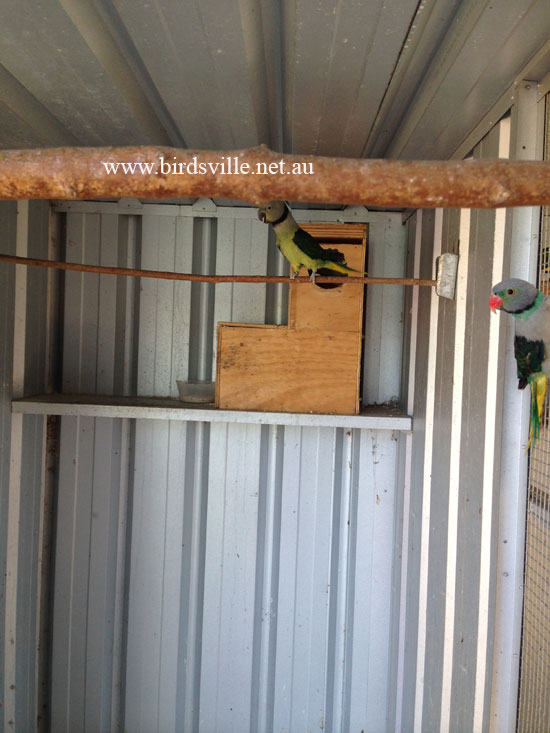
A male Malabar Parrot has a red upper beak with a pale tip and a blue-green band beneath its black collar, while a female has an all-black beak and only a plain black collar.
Male Malabar Parrot
Beak: red upper beak with a yellow-white tip
Collar: black, with a blue-green band below it
Head and body: grey head, green cheeks and blue central tail feathers
Female Malabar Parrot
Beak: black
Collar: black only, with no blue-green band
Head and body: less green on the face, with a greyer, paler body
Young birds have green heads, very pale orange beaks and duller collars. Australian breeders report that the male’s red beak can start showing from about 6 months of age. The full adult collar and colouring usually take until 18 to 24 months to develop, so young birds are easiest to sex once they’re over a year old.
How Do Malabar Parrots Breed?
Malabar Parrots usually lay 3 to 5 eggs in a clutch, and the hen incubates them alone for about three weeks.
Pairs are ready to breed from around 2 years of age and usually rear their young well. Give them a private aviary and a vertical nest box roughly 23cm square and 60cm tall, with a base of untreated Wood Shavings (https://petsville.com.au/products/martins-wood-shavings-30l). Chicks fledge at 6 to 7 weeks and become independent about a month later. Some pairs raise a second clutch in a season. Vetafarm Breeding Aid (https://petsville.com.au/products/vetafarm-breeding-aid-100ml) helps condition birds before laying. If you need to hand raise chicks, our Hand Raising Baby Birds page (https://birdsville.net.au/hand-raising-baby-birds/) explains the process.
What Records Should Malabar Parrot Owners Keep?
Log your Malabar’s weight once a week in a notebook or phone, and note each worming, mite spray and vet check.
Weight that keeps slipping is often the earliest warning of illness. The dates also remind you when the next 6-monthly worming is due.
Who Looks After a Malabar Parrot When You’re Away?
When you travel, arrange a daily visit from someone you trust or book your Malabar into bird boarding.
Write out the daily seed amount and which fresh foods your bird eats, and stick your avian vet’s number on the fridge. Going away for more than a few days? Our Bird Boarding in Sydney page (https://birdsville.net.au/parrot-bird-boarding-sydney/) explains how boarding works, and Petsville Hotel (https://www.petsvillehotel.com) is another option.
How Do You Transport a Malabar Parrot?
Transport a Malabar Parrot in a secure, ventilated carrier long enough for its tail, partly covered to keep it calm.
Drive straight there and keep the car cool. Even a few minutes in a closed, parked car can overheat a small parrot, so take it with you. Our Carry Cages page (https://birdsville.net.au/carry-cages/) shows the carriers we stock.
Can Malabar Parrots Live With Other Birds?
Malabar Parrots are best kept as a single pet or as one pair per aviary, and should never be housed with ringnecks or other Asiatic parrots.
That rule matters because any hybrid chicks dilute Australia’s small pure-bred population. Crowded mixed aviaries don’t suit them either. If young birds stay with their parents after fledging, separate them straight away if any aggression appears. Any newcomer should spend 4 to 6 weeks in quarantine before it meets your Malabars.
Malabar Parrot Frequently Asked Questions
Are Malabar Parrots good pets?
Yes, Malabar Parrots can be gentle, rewarding pets for owners with some parrot experience. Hand-raised birds bond well with their family and enjoy calm company. They need a long cage or aviary for their tail, daily fresh food, regular worming and mite control, and plenty of quiet time with their owners.
Can Malabar Parrots talk?
Only a little. Malabar Parrots can learn a few words, but they’re not strong talkers, despite a reputation that suggests otherwise. Most use their own keek-keek calls and soft chatter. If talking matters most to you, an Indian Ringneck is a better choice. Malabars are better loved for their calm nature and blue-grey colouring.
How often should I worm my Malabar Parrot?
Worm a new Malabar Parrot a few weeks to two months after bringing it home, then every 6 months. Don’t worm a freshly weaned baby straight away, as it can upset its developing gut bacteria. Birds in outdoor aviaries may need worming every 3 months. Ask the Birdsville team for the right timing.
What should I feed my Malabar Parrot?
Feed a Malabar Parrot Birdsville Blends Tropical Small Parrot or Tropical Large Parrot as the base, with fresh greens like broccoli and chickweed, some fruit and a few pellets. Soaked or sprouted seed adds extra nutrition. Millet sprays make good treats, and breeding birds benefit from egg food or insect protein.
How long do Malabar Parrots live?
A well cared for Malabar Parrot usually lives around 15 to 25 years. Good food, clean housing, regular worming and mite control, and yearly checks with an avian vet all help your bird reach the top of that range. Because they’re rare in Australia, finding an experienced avian vet early is worthwhile.
How big do Malabar Parrots get?
Adult Malabar Parrots grow to about 38cm long, but much of that length is their long, blue tail. Their bodies are slim and lightweight, similar in build to an Indian Ringneck. Because of that tail, they need a wide cage or aviary so the feathers don’t rub and break against the bars.
Is a Malabar Parrot the same as a Blue-winged Parakeet?
Yes. Malabar Parrot, Malabar Parakeet and Blue-winged Parakeet are all names for the same bird, Psittacula columboides, from the Western Ghats of southern India. Some older pet trade listings also call it the Bababudan Parrot. All of the care advice on this page applies whichever name you know it by.
Are Malabar Parrots endangered?
No, the Malabar Parrot is listed as Least Concern, but its numbers are thought to be slowly falling as forest in its small home range is cleared. It lives only in the Western Ghats of southern India, trade in wild birds is illegal there, and it’s listed on CITES Appendix II. Captive-bred birds are rare in Australia.
Can a Malabar Parrot live with an Indian Ringneck?
No. Malabar Parrots and Indian Ringnecks are closely related and can cross-breed. Hybrids harm the small population of pure Malabar Parrots in Australia, so keep them in separate cages or aviaries. Malabars suit life as a single pet or as a pair in their own aviary.
Recommended Avian Vets for Malabar Parrots in Sydney
SASH (Small Animal Specialist Hospital), 24/7 emergency. 5/476 Gardeners Rd, Alexandria NSW 2015. Phone 02 8913 4000. https://www.sashvets.com
The Wild Vet. 22A Bridge Road, Glebe. Phone 1300 945 3838. https://www.thewildvet.com.au
SERV. 57-63 Herbert St, Artarmon. Phone 02 9436 4884. https://www.exoticsvet.com.au
Southern Cross Veterinary Clinic. 60 Princes Hwy, St Peters. Phone 02 9516 0234. https://www.southerncrossvet.com.au
Carlingford Animal Hospital. 772 Pennant Hills Road, Carlingford. Phone 02 9871 6036. https://www.birdhealth.com.au
The Unusual Pet Vets. 995 Bourke Street, Waterloo NSW 2017. Phone 02 9319 6111. https://www.unusualpetvets.com.au
Vetafarm (avian health products). https://www.vetafarm.com.au
Sources
Size, diet, housing, sexing, breeding and conservation status: World Parrot Trust, Malabar Parakeet (https://parrots.org/encyclopedia/malabar-parakeet/)
Australian aviculture, lifespan, sexing age and hybrid risk: Aviculture Hub, Malabar Parakeet (https://www.aviculturehub.com.au/?p=6989)
Weight, cage size, colour maturity, noise and health: Furry Critter Network, Blue Winged Parakeet Species Guide (https://www.furrycritter.com/pages/descriptions/birds/blue_winged_parakeet.htm)
Breeding age: Oiseaux.net, Blue-winged Parakeet (https://oiseaux.net/birds/blue-winged.parakeet.html)
Range, breeding and talking reputation: Wikipedia, Blue-winged parakeet (https://en.wikipedia.org/wiki/Malabar_parakeet)
Worming, mites and training advice: Birdsville’s own experience hand raising Malabar Parrots
Shop Malabar Parrot Supplies at Petsville
Shop Malabar seed, pellets and health products online through Petsville (https://petsville.com.au/), delivered anywhere in Australia, or drop in to Birdsville at 684 Botany Road, Alexandria NSW 2015. Malabar owners often buy:
Birdsville Blends Tropical Small Parrot (https://petsville.com.au/products/birdsville-blends-tropical-small-parrot-500g)
Birdsville Blends Tropical Large Parrot (https://petsville.com.au/products/birdsville-blends-tropical-large-parrot-1kg)
Vetafarm Nutriblend Pellets Small (https://petsville.com.au/products/vetafarm-nutriblend-pellets-sml-350g)
Avitrol Mite and Lice Spray (https://petsville.com.au/products/fidos-avitrol-bird-mite-and-lice-spray-125ml)
Vetafarm Wormout Gel (https://petsville.com.au/products/vetafarm-wormout-gel-50ml)
Millet Sprays (https://petsville.com.au/products/millet-sprays-mixed-100g)
Follow us on Facebook (https://www.facebook.com/BirdsvilleRosebery/) and Instagram (https://www.instagram.com/petsvillesydney/) to see our birds, new arrivals and everyday care advice.


