
Eclectus Parrot For Sale Sydney
Last updated: October 2026
Written by the bird specialists at Birdsville, who have bred Eclectus parrots and rehome them across Sydney.
The spectacular Eclectus parrot is one of the most striking birds you can own, with bright green males and ruby red and blue females. Birdsville is a specialist bird and small animal store at 684 Botany Road, Alexandria NSW 2015, trading since 1985. If you’re looking for an Eclectus parrot for sale in Sydney, we can help in two ways. We rehome far more Eclectus parrots than we sell as babies, and Birdsville is known across Sydney for rehoming parrots. Many of the Eclectus in our care are wonderful adult birds looking for a second home. We also have hand-raised baby Eclectus available from time to time. This guide covers how to care for an Eclectus, and how our rehoming works if you’re thinking of adopting.
An Eclectus parrot needs a large cage, a fresh diet built on fruit, vegetables and quality pellets, plenty of toys and daily time with its family. With good care, an Eclectus commonly lives 30 to 50 years.
Eclectus Parrot Key Takeaways
Eclectus parrots should eat mostly fresh fruit and vegetables, with quality pellets and only a small amount of seed. Birdsville Blends Healthy Parrot was designed specifically for Eclectus parrots.
Eclectus parrots should not be given grit or cuttlebone. Calcium is best given through the water or a calcium perch.
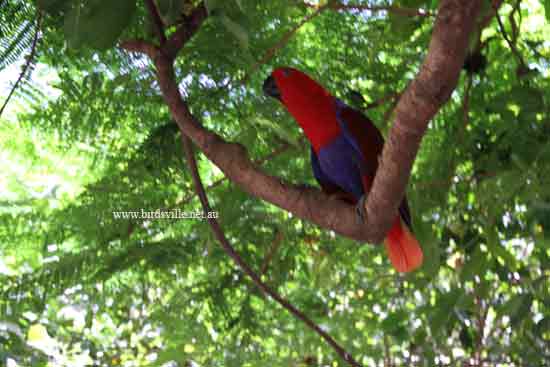
Male Eclectus parrots are green and female Eclectus parrots are red and blue, so they are easy to tell apart.
Eclectus parrots are very good talkers and are quieter than cockatoos.
Eclectus parrots commonly live 30 to 50 years, which is why many adult birds need new homes.
Birdsville in Alexandria, Sydney, rehomes more Eclectus parrots than it sells as babies, and surrendering a healthy bird is free.
Eclectus Parrot Quick Facts
Scientific name: Eclectus roratus (the pet subspecies in Australia is the Red-sided Eclectus, Eclectus roratus polychloros)
Other names: Eccy, Red-sided Eclectus
Native range: New Guinea, the Solomon Islands, nearby islands and Cape York Peninsula in Australia
Adult size: around 34cm long
Adult weight: 430 to 550g
Lifespan: commonly 30 to 50 years
Diet type: Herbivore, mainly fruit, vegetables, pellets and some seed
Minimum cage size: 91cm long x 61cm wide x 122cm high, bigger is always better
Noise level: moderate
Talking ability: very good
Experience level: Intermediate
On This Page
Eclectus Parrot Key Takeaways
How Does Eclectus Parrot Rehoming Work at Birdsville?
Do Eclectus Parrots Make Good Pets?
Essential Supplies
What Size Cage Does an Eclectus Need?
What Toys Do Eclectus Parrots Need?
What Do Eclectus Parrots Eat?
Providing Water
Do Eclectus Parrots Need Calcium and Vitamins?
How Do You Handle an Eclectus Parrot?
What Are Common Health Problems in Eclectus Parrots?
Parasite Control
Health, Hygiene and Safety
What Is Toxic to Eclectus Parrots?
How Can You Tell if an Eclectus Is Male or Female?
Are Eclectus Parrots Easy to Breed?
Record Keeping
Holiday Care and Boarding
Transportation
Compatibility with Other Animals
Frequently Asked Questions
Recommended Avian Vets for Eclectus Parrots in Sydney
Sources
How Does Eclectus Parrot Rehoming Work at Birdsville?
Owners who can no longer keep their Eclectus surrender it to Birdsville free of charge. We settle, worm and socialise the bird, then match it with a suitable new family for a rehoming fee.
Eclectus parrots live for decades, and life changes over that time. People move, their health changes or their work hours grow, and a much-loved bird sometimes needs a new home. Rehoming parrots is a big part of what we do at Birdsville, and Eclectus are one of the species we see most often. Read more on our Sydney Pet Bird Rescue page (https://birdsville.net.au/re-homing-parrot-adoption/).
Adopting a Rehomed Eclectus
A rehomed Eclectus is often already tame, talking and used to family life, which makes it a great choice for someone who wants an adult bird with an established personality. Every Eclectus that comes to us is settled into its own enclosure, fed a fresh diet, wormed and treated for mites. Once settled, the friendly birds take turns on our play stands so they stay social while they wait for a new family.
We don’t rehome a bird to just anyone. We’ll ask about your experience with parrots, what research you’ve done and the cage or aviary you have ready. A rehoming fee applies, which varies from bird to bird. If two birds have bonded, we try hard to rehome them together and offer a discount for taking a pair.
Surrendering Your Eclectus
Giving up a bird should always be a last resort, but if you need to, we’re here to help. There’s no charge to surrender a healthy bird to Birdsville. Call or email before you come in, and bring your Eclectus in a secure carrier. You’re welcome to bring its cage, toys and food as long as they’re clean and rust-free. A short note with your bird’s name, age, likes, dislikes and how it is with children helps us find the right match.
We can’t accept sick, injured or wild birds, because we aren’t a vet clinic and a sick bird puts our other animals at risk. An Eclectus with feather loss or plucking needs a recent vet report showing a clean bill of health.
How Long Does Rehoming Take?
Most birds find a new home within about a week, though some can take up to a month. Once your bird has been rehomed, we can’t share the new owner’s details for privacy reasons. Many adopters post updates on our Facebook page (https://www.facebook.com/BirdsvilleRosebery/), so keep an eye out.
Do Eclectus Parrots Make Good Pets?
Yes, Eclectus parrots make excellent pets for owners who can give them time, a fresh diet and plenty to do. They’re beautiful to look at and become an active member of the family. They’re very good talkers and will often surprise you with how clearly they pronounce their words. They’re also quieter than cockatoos, which suits many Sydney homes. For general advice that applies to all parrots, see our How to Care for Parrots guide (https://birdsville.net.au/pet-care-guides/how-to-care-for-parrots/).
For these birds, intelligence is the key. Fill their cage with toys they can chew, swing and play on. A busy Eclectus is a much happier bird, and plenty of toys greatly lowers the chance of bad habits like feather plucking or excessive squawking. If your bird is already noisy, our How to Stop Parrot Squawking and Screaming page (https://birdsville.net.au/screaming-and-squawking-parrots-how-to-stop/) can help.
Essential Supplies for Eclectus Parrots
Housing and Enclosure
A large, strongly built cage or aviary
Escape-proof clips for every door
Natural branch perches in a range of thicknesses (https://petsville.com.au/collections/perches)
A play gym or play stand
Water and Feeding
Heavy dishes for water, fresh food, pellets and seed (https://petsville.com.au/collections/bird-feeding-accessories)
Quality pellets (https://petsville.com.au/collections/bird-pellets)
A good quality parrot seed mix (https://petsville.com.au/collections/seed-1)
Fresh fruit and vegetables every day
Supplements
A calcium supplement for the water, such as Vetafarm Calcivet (https://petsville.com.au/products/vetafarm-calcivet-50ml), or a calcium perch (https://petsville.com.au/products/avian-care-trimming-calcium-perch-140mm-small)
A vitamin D supplement for birds kept indoors, such as Vetafarm Soluvite D (https://petsville.com.au/products/vetafarm-soluvite-d-25g)
Enrichment and Toys
Chewable wooden toys (https://petsville.com.au/collections/hanging-bird-toys)
Foraging and puzzle toys (https://petsville.com.au/collections/foot-toys)
A swing (https://petsville.com.au/collections/swings-ladders)
A bird bath or spray bottle
Hygiene and Cleaning
A bird-safe disinfectant (https://petsville.com.au/collections/cleaners-disinfectants)
Vetafarm Aviclens (https://petsville.com.au/products/vetafarm-aviclens-water-cleanser-100ml) or Multiclens for sprouting seeds
First Aid and Grooming
A digital scale for weekly weigh-ins
Styptic powder for minor nail or beak bleeds
Transport
A sturdy, well-ventilated carry cage, such as the Deluxe Parrot Carrier (https://petsville.com.au/products/bono-fido-deluxe-parrot-carrier)
What You May Consider
A bird harness for supervised outdoor time (https://petsville.com.au/products/avi-one-bird-harness-lead-small)
A full spectrum avian light for birds that get little natural sunlight
Every product mentioned on this page, and plenty more, is available in-store at Birdsville, and our team is happy to help you put the right setup together. You can also order online from our Petsville store (https://petsville.com.au/), with delivery Australia wide.
What Size Cage Does an Eclectus Need?
An Eclectus needs a cage of at least 91cm long, 61cm wide and 122cm high, with bars around 2 to 2.5cm apart. Eclectus spend much of the day climbing, so height and width both count. Buy the largest cage your space and budget allow, and your bird will be calmer and fitter for it.
Eclectus like to watch the household from a safe spot, so a lounge or family room works well. Cooking fumes make the kitchen a poor choice, and air conditioner vents or a heater blowing on the cage can chill or overheat your bird. Backing the cage onto a solid wall gives it a sheltered side to retreat to. Use natural branches for perches, since uneven wood exercises the feet far better than smooth dowel. There is no such thing as a cage too small.
What Toys Do Eclectus Parrots Need?
Eclectus parrots need chew toys, swings, climbing toys and foraging toys, rotated every week or two to stop boredom.
Eclectus parrots are clever and need a lot to keep their minds busy. Give them toys to chew, swing and climb on. Foraging toys that hide food are especially good, because foraging is a big part of an Eclectus’s day in the wild.
Most Eclectus love water. Many will happily splash in a wide, shallow dish, and others prefer a fine shower from a mister on a warm afternoon. Our own hens enjoy both. Introducing water early helps, because a bird that never bathed as a youngster may be wary of it later.
What Do Eclectus Parrots Eat?
Eclectus parrots eat mainly fresh fruit and vegetables, with quality pellets and a small amount of seed. In the wild they feed on fruit, figs, nuts, flowers and buds, so their digestion is built for fresh food. There’s a saying among breeders that Eclectus are “easy to breed and difficult to feed”, because they need a varied diet to stay healthy and keep good feather condition.
How Much to Feed
Offer a generous bowl of fresh fruit and vegetables every morning, and remove anything uneaten by the evening. Add a measured serve of pellets and a small amount of seed. As a guide, around half the diet should be fresh food. Weigh your bird weekly and adjust if its weight changes.
Seed
Feed your Eccy a good quality parrot seed mix. For young Eclectus, a standard parrot mix works well. For adults, we prefer a small parrot mix, as it has less sunflower seed.
Our top recommendation is Birdsville Blends Healthy Parrot (https://petsville.com.au/products/birdsville-blends-healthy-parrot-500g), which we designed specifically for Eclectus parrots and mix fresh in-store. Birdsville Blends Tropical Large Parrot (https://petsville.com.au/products/birdsville-blends-tropical-large-parrot-1kg) is another good option for extra variety. See the full range on our Birdsville Blends page (https://birdsville.net.au/birdsville-blends/).
Pellets
As Eclectus breeders, we’ve had great results with many pellets designed by vets in Australia and around the world. We recommend Vetafarm Paradise Pellets (https://petsville.com.au/products/vetafarm-paradise-pellets-2kg), Harrison’s High Potency (https://petsville.com.au/products/harrisons-high-potency-super-course-454g) and Passwell Parrot Pellets (https://petsville.com.au/products/passwell-parrot-pellets-1kg). Many Eclectus keepers avoid pellets with artificial colours, as Eclectus can be sensitive to them.
Sprouted Seed
Sprouted seed is a great addition to an Eclectus diet. You can buy a sprouting mix, or use a good quality cockatoo seed mix. Some breeders use just sunflower and safflower. Our Best Bird Treats page (https://birdsville.net.au/bird-treats-tips-and-sprouted-mix/) has more ideas for sprouted mixes and healthy treats.
How to Sprout Seeds for Eclectus Parrots
- Rinse the seed until there’s no trace of colour left in the water.
- Place the seed in a stainless steel dish, cover with water and soak overnight. Add Aviclens to the water, using the amount shown on the bottle. This step is very important, because it stops the bacteria that build up during soaking, which can make birds sick.
- The next day, rinse the seeds again.
- Place them in a closed plastic container or bag with holes poked in the bottom with a fork. This lets water drain and stops the seeds spoiling.
- Leave the container somewhere warm, such as a sunny window, to help the seeds germinate.
- Once the seeds have sprouted, after about 24 hours in summer or 48 hours in winter, rinse them again with Aviclens to remove any bacteria or fungus.
- Serve straight away.
Fruits and Veggie Guide
Fruits
Oranges, apples, plums, rockmelon, pear, pomegranate, strawberries, blueberries, guava, stone fruit, kiwi fruit and star fruit.
Vegetables
Seeding grasses, sweet potato, corn, spinach, broccoli, carrot, carrot tops, green beans, cucumber, capsicum and chilli.
H4: Avoid Entirely
Grit, lettuce, avocado, chocolate or anything containing cocoa, caffeine, alcohol, onion and salty or sugary human food.
With a healthy diet, your Eclectus parrot will become a very robust bird.
Providing Water to Your Eclectus
Eclectus often carry soft fruit to the water bowl, so it fouls faster than with seed-eating parrots. Use a weighty bowl that can’t be flipped, refill it with fresh water each morning and again whenever bits of food or cloudiness appear. Scrub it with hot water every day so slime doesn’t build up.
Do Eclectus Parrots Need Calcium and Vitamins?
Yes. Eclectus parrots need calcium and vitamin D, but they should get calcium through their water or a calcium perch, not from grit or cuttlebone.
Calcium
Don’t give Eclectus parrots shell grit or cuttlebone, as these can affect the crop. Instead, add calcium through the water supply or place a calcium perch in the cage.
Vitamin D
An Eclectus can’t use calcium properly without vitamin D, which it makes from direct sunlight on its feathers and skin. Sun coming through a closed window doesn’t count, because the glass blocks the UV rays that matter. Indoor birds benefit from a vitamin D supplement, sold either on its own or mixed with calcium.
Vitamins
Vitamin supplements can be given regularly to a bird on a mostly seed and fresh food diet. Go easy if your bird eats a lot of pellets, as pellets already contain added vitamins and Eclectus can react to too much.

How Do You Handle an Eclectus Parrot?
Handle an Eclectus calmly and confidently, reward good behaviour and spend time with it every day.
Make sure your Eclectus is socialised from a young age, ideally with another Eclectus of the opposite sex. This matters because an older bird can lose interest in its own kind once it reaches breeding age.
Behavioural enrichment keeps your bird’s mind active. When your Eclectus learns that good behaviour earns a reward, it tames up much faster. When handling your bird, be firm yet gentle. Never flinch or show fear, because this makes the bird feel dominant over you and encourages bad behaviour.
The best thing you can do for your bird is spend time with it, not spend money on it.
If your Eclectus bites too hard, stay calm, say “no” firmly and place it back in its cage for a short time out. Never hit your bird, as this only makes things worse. Our How to Train Your Parrot page (https://birdsville.net.au/pet-bird-advice-and-training/bird-training-clicker-training-parrot-body-language/) has more tips, and our Parrot Biting and Aggression page (https://birdsville.net.au/parrot-biting/) explains why parrots bite and how to stop it.
What Are Common Health Problems in Eclectus Parrots?
The most common health problems in Eclectus parrots are vitamin A deficiency, toe tapping and wing flipping, feather plucking and Beak and Feather Disease.
Vitamin A Deficiency
A mostly seed diet lacks vitamin A, which can lead to breathing problems, sinus infections and poor feather condition. Orange and dark green foods like sweet potato, carrot and spinach are rich in vitamin A.
Toe Tapping and Wing Flipping
Toe tapping and wing flipping are habits seen mainly in Eclectus parrots, where the bird clenches its toes or flicks its wings over and over. Many keepers link this to diet, especially too many added vitamins or artificial colours. If you notice it, take your bird to an avian vet and review its diet.
Feather Plucking
Feather plucking in Eclectus parrots is most often caused by boredom, but diet, stress and illness can play a part too. Plenty of toys and attention prevent most cases. Our Feather Plucking in Parrots page (https://birdsville.net.au/pet-bird-advice-and-training/feather-plucking/) covers causes and treatment.
Beak and Feather Disease (PBFD)
Psittacine Beak and Feather Disease is a contagious virus that damages feathers, beaks and the immune system, and is most often seen in young birds. Our Common Bird Illnesses page (https://birdsville.net.au/common-bird-illnesses/) covers it in more detail.
Parasite Control
Worm your Eclectus regularly with a bird wormer such as Avitrol Plus Bird Worm Syrup (https://petsville.com.au/products/fidos-avitrol-plus-bird-worm-syrup-25ml), and check for mites and lice. If you find any, treat with a bird mite and lice spray such as Avitrol Mite and Lice Spray (https://petsville.com.au/products/fidos-avitrol-bird-mite-and-lice-spray-125ml). Eclectus are sensitive to these sprays, so use half the usual dose. A newcomer should live in a separate room from your other birds for 4 to 6 weeks before they meet. Every Eclectus that comes into our rehoming program is wormed and treated for mites when it arrives.
Health, Hygiene and Safety
Every day: clear away leftover fruit and vegetables before they spoil, refresh the water and change the tray liner.
Every week: scrub the food bowls in hot soapy water and scrape droppings off the perches.
Every month: take out the furnishings and disinfect the whole cage with a bird-safe cleaner.
Throw out chewed-through toys and cracked dishes, and swap in new perches once the old ones wear smooth.
What Is Toxic to Eclectus Parrots?
Avocado, chocolate, caffeine, alcohol and onion are toxic to Eclectus parrots, along with non-stick cookware fumes, aerosol sprays, and lead or zinc in old cages and toys.
As well as the foods under Avoid Entirely, watch for these hazards around the home:
Fumes from overheated non-stick pans, which can kill a bird within minutes
Smoke, fly spray, room deodorisers and perfumed candles
Old galvanised wire, keys, jewellery and painted toys that may contain lead or zinc
Indoor plants you haven’t checked as bird-safe
Open doors and windows, spinning ceiling fans and hot cooktops during time out of the cage
The family cat or dog, even if they seem uninterested
How Can You Tell if an Eclectus Is Male or Female?
Eclectus are one of the easiest parrots to sex, because males and females look completely different. Young birds show their colours from the time their feathers grow in.
Male Eclectus
Colour: bright green, with red and blue under the wings
Beak: orange upper beak with a yellow tip
Personality: usually gentle, easygoing and sometimes a little timid
Female Eclectus
Colour: ruby red, with a blue or purple chest
Beak: black
Personality: usually bold, confident and protective of her cage
Are Eclectus Parrots Easy to Breed?
Once you have a young, healthy pair of breeding age, Eclectus parrots are relatively easy to breed. Most pairs need to be 2 to 3 years old first.
In our experience, waiting for a pair to reach breeding age is a long wait, but well worth it. Early on, we went through a number of pairs with no success. They were in perfect feather and looked like great breeding birds, but in time we realised they were either too old or infertile.
That’s why we recommend anyone starting out begins with young birds and is patient. Plenty of people sell birds that are too old or simply infertile.
With a good breeding pair, the main thing to get right is food. It must be plentiful, especially while they’re raising young. Eclectus breed well in both nesting logs and nest boxes. If you plan to hand raise the chicks, our Hand Raising Baby Birds page (https://birdsville.net.au/hand-raising-baby-birds/) explains how.
Record Keeping
A kitchen scale and a notebook are all you need. Record your Eclectus’s weight in grams once a week, since a steady drop usually shows up before any other sign that something is wrong. Keep a log of worming dates, moults and vet visits too. If you ever need to rehome your bird, these records help us find it the right family.
Holiday Care and Boarding
An Eclectus diet is heavy on fresh produce, and chopped fruit goes off within a day in warm weather. That makes a daily visit from a friend or sitter essential if you’re away, both for fresh meals and some company. For longer trips, Petsville Hotel (https://www.petsvillehotel.com) offers bird boarding.
Transportation
For vet visits or a move, a solid carrier with airflow on several sides is safest. Drape a light towel over part of it so your Eclectus feels hidden, run the air conditioning on hot days, and take the bird with you every time you leave the car.
Compatibility with Other Animals
Eclectus can live with another Eclectus, but introduce them slowly and supervise closely, especially two females, who can be territorial. Never house them with much smaller birds, and keep them away from cats and dogs. Always quarantine a new bird for 4 to 6 weeks first.

Eclectus Parrot Frequently Asked Questions
Can I adopt an Eclectus parrot from Birdsville?
Yes. We rehome far more Eclectus parrots than we sell as babies. Many are adult birds that are already tame and talking. We’ll ask about your experience and setup to make sure it’s a good match, and a rehoming fee applies. Visit our Sydney Pet Bird Rescue page or call in to see who’s looking for a home.
Can I surrender my Eclectus to Birdsville?
Yes, as long as your bird is healthy. There’s no charge to surrender a healthy Eclectus. Please call or email before coming in. We can’t accept sick or injured birds, and a bird with feather loss needs a recent vet report. We’ll care for your bird until we find it a suitable new home.
How long do Eclectus parrots live?
With good care, Eclectus parrots commonly live 30 to 50 years, and some have been recorded living longer. That’s a long commitment, which is one reason so many adult Eclectus need new homes. Plan ahead and think about who would care for your bird if your circumstances change.
Do Eclectus parrots talk?
Yes. Eclectus are very good talkers and are known for clear, well pronounced speech. Many learn dozens of words and phrases, along with whistles and household sounds. Talking varies between birds. With daily chat and patience, most Eclectus become confident talkers. Many rehomed adults already talk well.
Are Eclectus parrots noisy?
They’re quieter than cockatoos and many other large parrots, which makes them popular in Sydney homes but there is no way we can say they are not noisy. Eclectus still call loudly at times, especially in the morning and evening, and a bored bird can squawk a lot. Plenty of toys and daily attention help keep the noise down.
Are Eclectus parrots good for beginners?
They can be, for a committed beginner who has done their research. Eclectus are gentle, quieter than cockatoos and talk well, but they need a fresh food diet every day, a large cage and daily attention. A calm, tame adult from our rehoming program is often an easier start than a young baby.
Do male or female Eclectus make better pets?
Both make lovely pets, but they have different personalities. Males are usually gentler, more easygoing and sometimes a little timid. Females tend to be bolder, more confident and more territorial around their cage. Choose the bird whose personality suits your household rather than the sex alone, and meet the bird first if you can.
Recommended Avian Vets for Eclectus Parrots in Sydney
SASH (Small Animal Specialist Hospital), 24/7 emergency. 5/476 Gardeners Rd, Alexandria NSW 2015. Phone 02 8913 4000. https://www.sashvets.com
The Wild Vet. 22A Bridge Road, Glebe. Phone 1300 945 3838. https://www.thewildvet.com.au
SERV. 57-63 Herbert St, Artarmon. Phone 02 9436 4884. https://www.exoticsvet.com.au
Southern Cross Veterinary Clinic. 60 Princes Hwy, St Peters. Phone 02 9516 0234. https://www.southerncrossvet.com.au
Carlingford Animal Hospital. 772 Pennant Hills Road, Carlingford. Phone 02 9871 6036. https://www.birdhealth.com.au
The Unusual Pet Vets. 995 Bourke Street, Waterloo NSW 2017. Phone 02 9319 6111. https://www.unusualpetvets.com.au
Vetafarm (avian health products). https://www.vetafarm.com.au
Sources
Size, weight, lifespan, cage size and common health problems: Lafeber Vet, Eclectus parrot species profile (https://lafeber.com/vet/?p=4070)
Rehoming process: Birdsville Sydney Pet Bird Rescue (https://birdsville.net.au/re-homing-parrot-adoption/)
Diet, sprouting, calcium and breeding advice: Birdsville’s own experience breeding and rehoming Eclectus parrots
Thinking of adopting or rehoming an Eclectus? Visit our Sydney Pet Bird Rescue page (https://birdsville.net.au/re-homing-parrot-adoption/) or come and see us at 684 Botany Road, Alexandria NSW 2015. You can also follow us on Facebook (https://www.facebook.com/BirdsvilleRosebery/) and Instagram (https://www.instagram.com/petsvillesydney/) to see which birds are looking for new homes.


