Indian Ringneck care guide
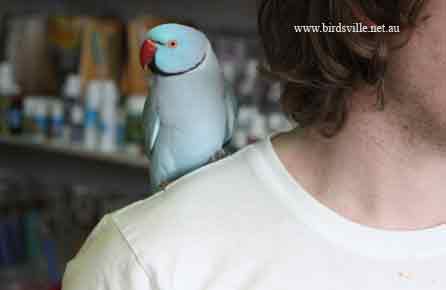
Availability at birdsville
Hand raised Indian ringnecks are only available at one period a year as they only breed once a year.
Ringnecks as pets
The fact is, that these birds make wonderful pets with training. Many people are turned off by young Indian Ringnecks as they often become a bit nippy after being weaned, this is due to hormones running through their body. With patience, the right training and care, your bird will soon overcome this stage and become a fantastic Hand Raised bird. So never give up on your bird it is the worst thing you can do. Ringnecks that are handled regularly become a very sweet bird with a pleasant nature. These birds are very intelligent and toys are very important. With the right training these birds can also talk.
Distribution
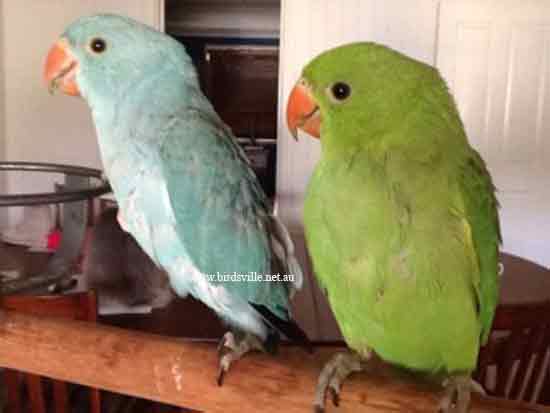
These birds’ natural habitat semi desert, open shrub and bushland and ever green forest in India and Asia. They also inhabit gardens orchards towns and cities where they rely on rich fruit bearing vegetation and locals who feed them. The Indian Ringneck have become introduced pests in some countries and has the potential to become another introduced pest in Australia. With the right precautions and care we can greatly reduce this possibility.
Description and Sexing Indian Ringneck Parrot’s
The Indian ringneck in its natural form is a medium to small sized parrot with a red hooked beak and a long tail. They are 37 cm to 43 cm long including the tail and green in color. A mature male will develop a black and pink ring around its neck around two years of age, where females will never develop a ring, like a juvenile. In captivity there are many variations in color. Colors range from bright yellow, blue, albino to violet and mixed variations.
Care and feeding Indian ringneck parrot’s.
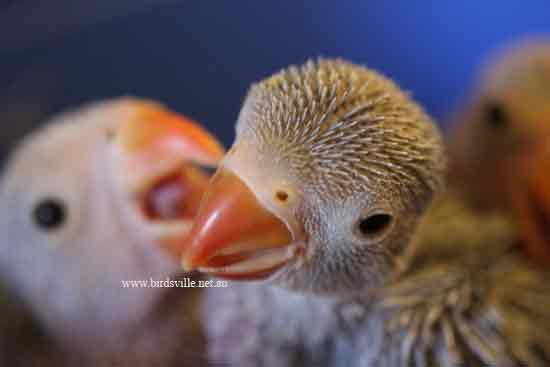
feeding your ringneck does not need to be complicated as they are good eaters. These birds will always eat their favorite food usually the least healthy food first. This is not as issue leave the food there and they will eat the rest. Your bird having a varied diet will increase the health of your birds so if they still have pellets and seed left then there is no need to throw it out. This does not include birds under 4 months old as they should be fed an all you can eat buffet.
Diet for Indian Ringneck’s
Seed-Feed your Ringneck’s a good quality small parrot seed, this seed is advisable as it does not contain as much sunflower as the normal Parrot mix. Be wary of some supermarket mixes as the quality may be low grade, if you are unsure of the seed, you are using ask your local bird expert.
Sprouted seed– use a cockatoo seed mix to make your sprouted seed mix and be sure to clean your sprouted seed with aviclens before feeding to your birds to remove any bacteria.
Pellets– Feed in a separate dish not with the seed if you want to get the best value and less waste. Many people find their bird will prefer to eat seed, which is normal, do not feed your bird more seed until both the pellets and seed dishes are empty. Suitable mixes for Indian ringnecks are Murphy’s pellets, Peckish, vetafarm nutriblend pellets, vetafarm paradise pellets. I have trialed all of these pellets and they have all shown great results in bringing out the best in your feathered friends keeping them in optimum health.
Fruit– apples, guava, mango, pear, stone fruit, rock melon, orange, grapes in moderation
Greens and Vegetables– corn, pumpkin, sweet potato, spinach, silver beet, seeding grasses, green grass, chickweed, green beans, cucumber, broccoli, squash, Bok choy.
Vitamin Supplement– added via the water supply, this is not necessary if you feed your bird any of the pellets mentioned above.
Calcium– Calcium perches or calcium bells are recommended for these birds I don’t recommend cuttlebone for Asiatic parrots.
Vitamin D supplement– Essential for Indian Ringnecks that are inside and do not receive direct unfiltered sunlight. Sun through a window is filtered so will not allow your bird to absorb vitamin D. Birds and humans as well are unable to absorb calcium without vitamin D supplement.
Fresh water–
Do not feed Indian Ringnecks avocado, onion or cocoa.
Diet for a baby indian ringneck
Young birds should be provided with an all you can eat buffet of fruit, veg, nuts, pellets and seed. Unlike older birds where you would leave the food until they have dated it all younger birds can be picky and need more encouragement to feed. Baby birds having too much fatty food isn’t as much of an issue as it is for a mature bird.
Housing for tame ringnecks
When looking for a cage to house your Indian Ringneck, you want to look for a cage that is large enough for your bird to stretch its wings and have a flap without hitting any toys and food bowls or the side of the cage. Your cage must have room for at least 3 to 4toys and 3 food bowls. Keeping all this in mind when buying a cage and get the largest cage you can afford to make sure your bird remains happy, healthy and tame. The team at Birdsville can help you with the selection.
Indian Ringnecks with the wrong environment or allow to get bored, in time will develop behavior problems, such excessive chirping or feather plucking and self-mutilation. It is much easier to prevent these problems them to solve them. Selecting toys that they can chew on, climb on with different textures like leather and wood. Toys encourages natural foraging behavior or a puzzle they have to solve to get treats, as well as swings, bells and ladders.
Rotating toys are a good idea, so your bird doesn’t get bored with their toys. Natural tree branches with leave, also provide a good distraction for your bird. Remember to clean branches under running water before fiving to your bird. if your bird is outside, it is imperative that your bird has sufficient protection from the elements. Direct sun can cook and kill a bird and shelter from the rain.
Introducing your new bird to existing birds and mixing birds
If you already have an Indian Rink neck at home and you get a second one, it is important once you take your new bird home you should keep it in a separate cage and allow the bird to adjust to the environment. Place the two enclosures side by side to allow the two birds to get to know each other. Always allow at least 2 weeks before introducing the new bird to an existing bird outside the cages or in the same cage. Use this time to get to know your new ringneck and start training.
Your new ringneck will need to be wormed in a few weeks to two months after being taken home (check with the staff from Birdsville, when purchasing). Young birds that have been recently weaned have a delicate bacteria’s developing in their gut, worming at this stage could harm the bacteria’s development and your new bird. Worming will need to be done.
every 6 months. Worming your bird is essential for the health of your Indian Ringneck.
The two most common parasites that you may encounter when owning an Indian Ringneck is lice and mites, but they are easily controlled with a spray, which is available at Birdsville.
Training
Training your ringneck is an important factor of having a well-behaved hand raised bird. You need to handle your bird in a quiet, relaxed situation. Spending time with your bird while watching TV or reading is perfect, but don’t over stress your bird in the first few weeks of taking it home babies need rest. The more time you spend with your ringneck, the better it will become. Indian Ringnecks can be tame when you purchase them and turn wild after a few days, this is quite normal with young birds as the hormone’s levels are very high at this age which is probably a survival tactic in the wild. If this happens it is essential that you handle the bird as much as possible. The worst thing you can do is not handle the bird because you are scared of being bitten, your bird will turn wild if it is not handled. If you are scared of the bird place some gloves on and handle the bird for lengthy periods of time while you are reading or watching tv and it will not take long before your bird settles down and loves your company. Remember your bird will not get a chance to bond with you if your not handling the bird.
Enrichment
Toys are used as a form of environmental enrichment but enrichment shouldnt stop there. As an ex-zookeeper it was a major concern that all animals must have a variety environmental enrichment to keep the critters entertained. This is in no way different for anyone who has a tame parrot at home. Enrichment is important because parrots simply cannot thrive with only perches, food and water. The fact is birds provided with enrichment are unlikely to developed psychological problems such as self-mutilation, feather plucking and excessive squawking. Enrichment WILL in fact effect your bird in a positive way with its mental and physical development when training your bird, you will actually end up with a better, less fearful, friendlier and relaxed bird which will be more easily trained. Enrichment for your Indian Ringneck can be chewing toys, play toys, leather toys, acrylic plastic toys, wooden toys, shredding toys, ropes, swings, ladders, bells, balls, birdie balls, plain cardboard, small boxes, wicker baskets, tray of wheat grass, plants, bird baths, different foods, food kabobs and nuts, just to name a few (all available at birdsville). You may also find in your local area pinecones, hide food inside pinecones, twigs, bendy branches, flowers and branches- safe flowers are bottle brush, grevilia, eucalypt melaleuca flowers, hubiscus, marygolds, dandy lions leaves and all, roses, violets to name a few.
Note anything found outside should be disinfected and non-poisonous. Toys must be non-toxic.
Enrichment tip- the trick to keeping them entertained is regularly rotating toys as they will become bored with the same toy in their cage day after day. Changing them regularly will create interest for your Ringneck as if they are receiving a whole new toy to play with.