Last updated: October 2026
Written by the Birdsville team.
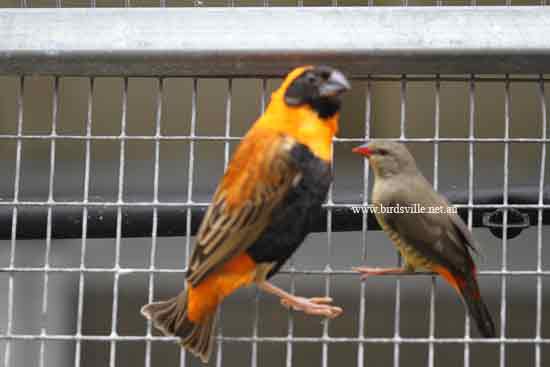
The Madagascar Weaver, also called the Red Fody or Madagascar Fody, is a small weaver from the island of Madagascar. In the breeding season the male turns a brilliant red with black around the eyes, while the hen stays olive brown all year. Madagascar Weavers are active, hardy birds that do best in a planted aviary. They eat a quality finch seed mix with sprouted seed, greens, grit, egg and biscuit and live food, and unlike most finches, the male weaves his own nest from long grass and plant strips. This page covers where Madagascar Weavers come from, how to tell males from females, housing, diet, breeding and how to keep them healthy. Birdsville in Alexandria stocks everything you need to keep them.
Madagascar Weaver Key Takeaways
Madagascar Weavers, also called Red Fodies, come from the island of Madagascar.
Males turn bright red in the breeding season, but outside it males and females look almost identical.
They eat finch seed, sprouted seed, millet sprays, greens, grit, egg and biscuit, and live food.
The male builds the nest, so they need thick dried brush and plenty of long grass and palm leaf strips.
They won’t use ordinary finch nests.
Hens lay around 4 pale blue eggs and incubate them for about 14 days.
Birdsville Blends Finch and Canary is our recommended seed for Madagascar Weavers.
Birdsville at 684 Botany Road, Alexandria stocks the seed, supplements and nesting supplies Madagascar Weavers need.
Madagascar Weaver Quick Facts
Scientific name: Foudia madagascariensis
Other names: Red Fody, Madagascar Fody, Red Cardinal Fody
Size: about 13cm long
Weight: about 14 to 19 grams
Native range: Madagascar, and introduced to Mauritius, Réunion, the Seychelles, the Comoros and other Indian Ocean islands
Habitat: forest clearings, grasslands and farmland, but not dense forest
Temperament: active and lively, males become territorial when breeding
Experience level: intermediate
Clutch: around 4 pale blue eggs
Incubation: about 14 days
Breeding season: around September to May
Where Do Madagascar Weavers Come From?
Madagascar Weavers come from Madagascar, the large island off the south east coast of Africa.
They live in forest clearings, open grassland and farmland, but not in dense forest. They’re so common around rice fields in Madagascar that farmers there treat them as a pest. People have also taken them to many other Indian Ocean islands, including Mauritius, Réunion and the Seychelles. Wikipedia (https://en.wikipedia.org/wiki/Red_fody) has more on Madagascar Weavers in the wild.
How Do You Tell a Male Madagascar Weaver From a Female?
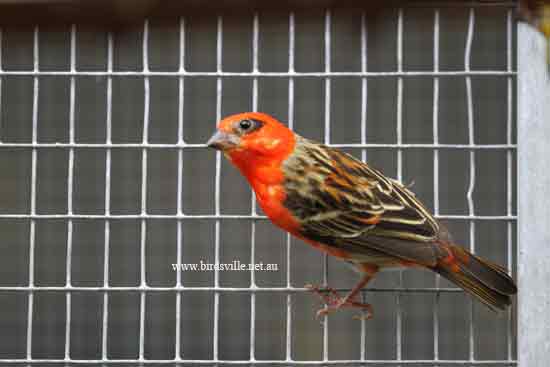
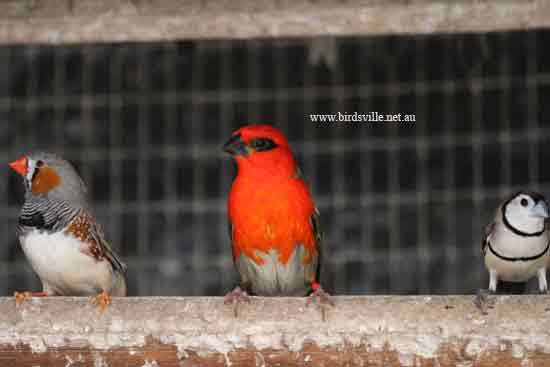
In the breeding season, male Madagascar Weavers are easy to spot, as they turn bright red with black around the eyes and brown wings and tail.
Hens are olive brown on top and greyish brown underneath all year round. Outside the breeding season, the male loses his red colour and looks almost identical to the hen, so they are very difficult to sex. The easiest time to pick your pairs is when the males are in full colour. DNA testing is the only way to be completely sure at other times.
How Do You House Madagascar Weavers?
Madagascar Weavers do best in a well planted aviary with thick shrubs or dried brush, where the male can build and the birds have room to fly.
Give them a sheltered, draught free area and always have a clean bathing dish available, as weavers love to bathe. Males claim a territory as the breeding season starts, so give them plenty of space and avoid crowding the aviary. Our guide to finch cages and aviaries (https://birdsville.net.au/finch-cages-aviaries/) covers aviary setup in detail.
What Do Madagascar Weavers Eat?
Madagascar Weavers eat a quality finch seed mix, plus sprouted seed, millet sprays, greens, grit, egg and biscuit, live food and a regular vitamin boost.
Seed
A good quality finch mix is essential, especially for breeding Madagascar Weavers. Our first choice is Birdsville Blends Finch and Canary (https://petsville.com.au/products/birdsville-blends-finch-canary-500g), made fresh in store, and Basic Finch Mix (https://petsville.com.au/products/avigrain-seed-finch-blue-2kg) is a good everyday option. Be wary of some supermarket brands, as they contain many seeds that don’t do much for keeping and breeding weavers. As well as finch mix, Madagascar Weavers will eat oats, linseed, rape seed and sunflower. Our Finch Seed page (https://birdsville.net.au/seeds-grains/finch-seed/) has more.
Sprouted Seed
Sprouted seed is especially important for weavers, so feed it regularly. Always wash it thoroughly with Vetafarm Aviclens (https://petsville.com.au/products/vetafarm-aviclens-water-cleanser-100ml) before feeding to remove bacteria. Our Best Bird Treats page (https://birdsville.net.au/bird-treats-tips-and-sprouted-mix/) explains how to sprout seed.
Millet Sprays
Millet sprays make a good treat for weavers. Hang Millet Sprays (https://petsville.com.au/products/millet-sprays-mixed-100g) in a Millet Spray Holder (https://petsville.com.au/products/jw-insight-feeder-millet-spray-holder) to keep them clean.
Greens
Offer seeding grasses, dandelion, chickweed, endive and the flowering heads of milk thistle. Make sure anything you pick is free of pesticides.
Live Food
Live food is important for these insect eating birds. Offer mealworms and fly pupae with some added Vetafarm Insectivore Rearing Mix (https://petsville.com.au/products/wombaroo-insectivore-rearing-mix-250g).
Egg and Biscuit
Egg and biscuit formula, such as Shep’s Egg and Biscuit (https://petsville.com.au/products/sheps-egg-biscuit-500g), is great extra protein for Madagascar Weavers. For an extra boost, mix in some chopped boiled egg.
Grit
Offer a good quality grit with charcoal, shell, baked egg shell, crushed cuttlebone and limestone, such as Shell Grit (https://petsville.com.au/products/shell-grit-5kg), in its own dish.
Vitamins
Every bird benefits from a regular vitamin boost. Add vitamins such as Vetafarm Multivet (https://petsville.com.au/products/vetafarm-multivet-50ml) to the water regularly.
How Do You Breed Madagascar Weavers?
Madagascar Weavers breed from around September to May, and the male weaves a round nest in thick dried brush rather than using a finch nest box.
The male does the building, so give him plenty of nesting material, such as long grass in many different lengths and strips of palm leaf, plus Swamp Grass (https://petsville.com.au/products/breeders-delight-nesting-material-swamp-grass-50g). Once the hen approves of his nest, she lays around 4 pale blue eggs and incubates them for about 14 days while the male guards the nest. The hen alone feeds the chicks for about 3 weeks until they start to leave the nest, and then both parents keep feeding them for up to 4 more weeks while they learn to feed themselves. Throughout breeding, make sure they have plenty of live food and egg and biscuit.
Why Won’t My Madagascar Weavers Use a Finch Nest?
Madagascar Weavers build their own nests, so they won’t nest in ordinary finch boxes or wicker nests. Give them a thick bunch of dried brush to build in and a big supply of long grass and palm leaf strips. If a hen doesn’t like what the male has built, he may abandon it and start again, so keep the material coming.
How Do You Keep Madagascar Weavers Healthy?
Keep Madagascar Weavers healthy with a varied diet, fresh drinking and bathing water every day, a draught free aviary and regular cleaning.
Change water and seed daily, clean the aviary each week with a bird safe disinfectant, and keep new birds apart for 2 weeks before they join your others. A bird that sits fluffed up and quiet may be unwell, so see an avian vet. Our Common Bird Illnesses page (https://birdsville.net.au/common-bird-illnesses/) lists the warning signs.
How Does Sydney’s Weather Affect Madagascar Weavers?
Madagascar Weavers come from a warm island climate, so they enjoy Sydney’s warmer months but need shelter from cold winter nights.
Their breeding season runs from around September to May, so spring is the time to put out dried brush and plenty of long grass and palm leaf strips, and to start increasing live food. In summer, make sure there’s shade and a clean bathing dish every day. In winter, keep part of the aviary fully covered and draught free.
A Tip From Our Staff
Don’t bother putting finch nests in with your Madagascar Weavers, because they won’t use them. Pack a corner of the aviary with thick dried brush and give the male a big pile of long grass and palm leaf strips in lots of different lengths. Let him build, and let the hen choose.
Madagascar Weaver Frequently Asked Questions
Are Madagascar Weavers good for beginners?
Madagascar Weavers suit keepers with a little aviary experience. They’re hardy and active, but they need a planted aviary with room to build and plenty of nesting material, and males become territorial in the breeding season. Feed a quality finch seed mix, sprouted seed, greens, live food and egg and biscuit.
How do you tell male and female Madagascar Weavers apart?
In the breeding season, males turn bright red with black around the eyes, while hens stay olive brown. Outside the breeding season, the male loses his red colour and the two look almost identical, which makes them very hard to sex. DNA testing is the only way to be certain then.
What do Madagascar Weavers eat?
Madagascar Weavers eat a quality finch seed mix, plus oats, linseed and some sunflower, sprouted seed, millet sprays, greens such as chickweed and dandelion, grit, egg and biscuit, and live food like mealworms and fly pupae. Add vitamins to their water. Birdsville Blends Finch and Canary is our recommended seed.
Do Madagascar Weavers use nest boxes?
No, Madagascar Weavers won’t use ordinary finch nest boxes or wicker nests. The male weaves his own round nest in thick dried brush. Give him plenty of long grass in different lengths, palm leaf strips and swamp grass to build with, and the hen will choose whether she likes the result.
When do Madagascar Weavers breed?
Madagascar Weavers breed from around September to May. The male builds the nest, and the hen lays about 4 pale blue eggs that hatch after around 14 days. The chicks leave the nest at about 3 weeks old, and the parents feed them for up to 4 weeks more.
Is a Madagascar Weaver the same as a Red Fody?
Yes, the Madagascar Weaver and the Red Fody are the same bird, Foudia madagascariensis. It’s also called the Madagascar Fody and, on Mauritius, the Red Cardinal Fody. Bird keepers in Australia usually call it the Madagascar Weaver, because it belongs to the weaver family and builds a woven nest.
Where Can I Buy Madagascar Weaver Supplies in Sydney?
Birdsville stocks everything you need to keep Madagascar Weavers, from finch seed and sprouting seed to live food, insectivore mix, nesting material and vitamins, at 684 Botany Road, Alexandria NSW 2015, servicing the Eastern Suburbs and Inner South Sydney. Visit us or call (02) 9669 1766, and our team will help you with diet, housing and breeding advice. We’re open 9:30am to 5:30pm weekdays, 10am to 5pm Saturday and 10am to 4pm Sunday, with directions on our Contact page (https://birdsville.net.au/contact-birdsville/). Follow us on TikTok ([ADD TIKTOK LINK]), Facebook (https://www.facebook.com/BirdsvilleRosebery/) and Instagram (https://www.instagram.com/petsvillesydney/) for live updates and bird care tips.
Petsville (https://petsville.com.au/) ships finch seed and supplies anywhere in Australia, including our Birdsville Blends Finch and Canary. Seed can’t be sent to WA or Tasmania because of quarantine laws.
Popular Madagascar Weaver supplies on Petsville:
Birdsville Blends Finch and Canary (https://petsville.com.au/products/birdsville-blends-finch-canary-500g)
Vetafarm Insectivore Rearing Mix (https://petsville.com.au/products/wombaroo-insectivore-rearing-mix-250g)
Shep’s Egg and Biscuit (https://petsville.com.au/products/sheps-egg-biscuit-500g)
Swamp Grass Nesting Material (https://petsville.com.au/products/breeders-delight-nesting-material-swamp-grass-50g)
Vetafarm Aviclens (https://petsville.com.au/products/vetafarm-aviclens-water-cleanser-100ml)
Vetafarm Multivet (https://petsville.com.au/products/vetafarm-multivet-50ml)
About Birdsville
Birdsville has been at 684 Botany Road, Alexandria NSW 2015 since 1985, and we believe we’re now the oldest bricks and mortar bird shop still trading in Australia. Owner Ash brings experience from vet clinics and from the Rainforest Habitat in Port Douglas, now Wildlife Habitat. We’re a small business that does things in a big way, and we keep our products the best of the best.
Sources
Wild range, habitat, size, weight, sexing, nesting and other names: Wikipedia, Red Fody
Diet, breeding and nesting advice: the Birdsville team
Product details: Petsville product listings