
Written by the Birdsville team. Last updated October 2026.
Feather plucking is when a parrot pulls out, chews or damages its own feathers, anywhere its beak can reach. It’s one of the most common health and behaviour problems in pet parrots, and there’s no single medication that fixes it. Plucking is rarely caused by disease alone. In most cases it’s a behaviour with an underlying trigger, usually diet, environment or stress.
This guide is based on our own experience helping plucking parrots that come through Birdsville for rehoming and boarding. It covers why parrots pluck, how to spot it early, and exactly how to stop it, with a product and fix guide matched to different species.
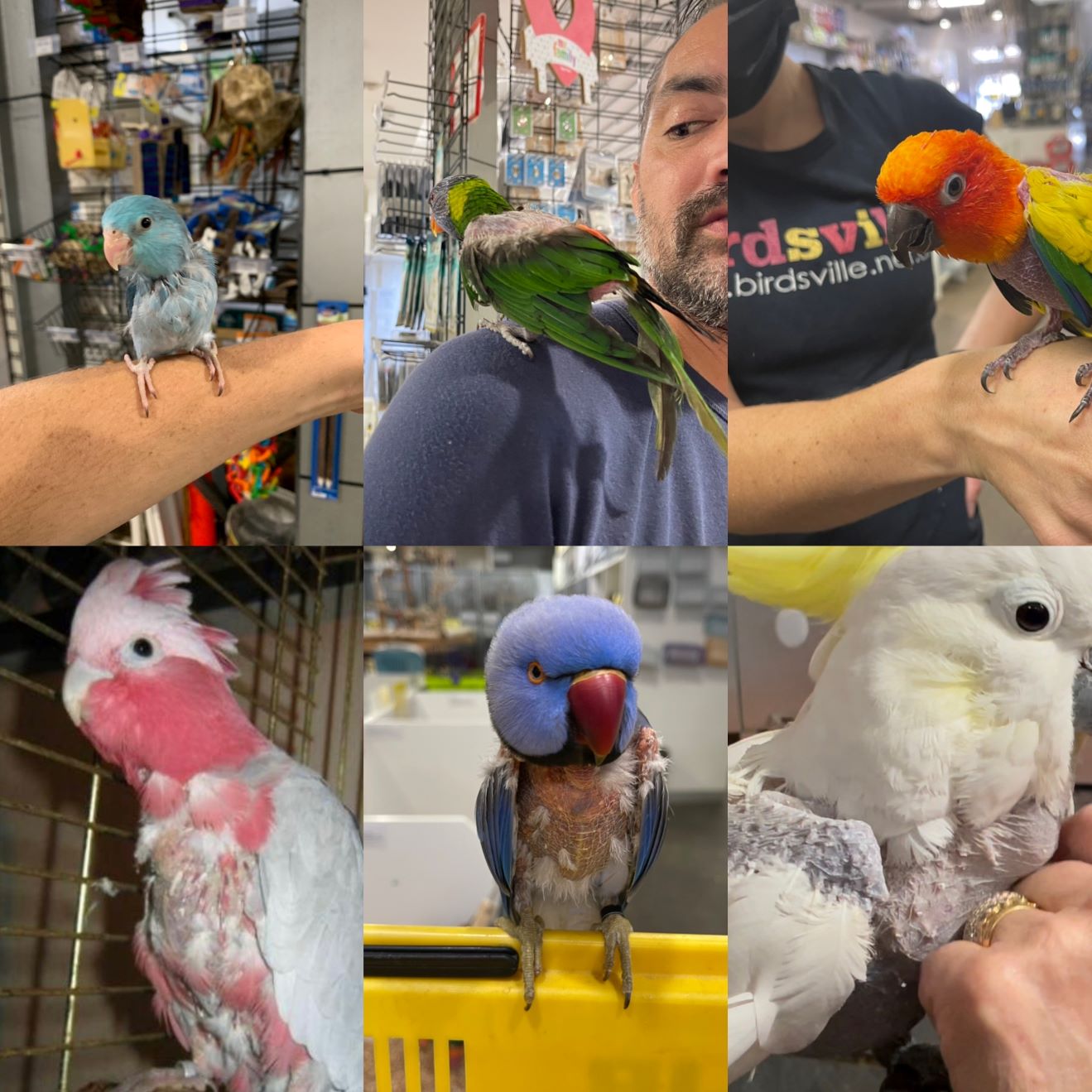
Quick Answer: How Do You Stop a Parrot Plucking?
- Fix the diet first. Feed a quality seed blend with pellets, and cut out sunflower, peanuts and junk food.
- Add vitamins, a probiotic and vitamin D, especially for indoor birds.
- Give at least 8 toys and rotate them often.
- Make sure your parrot gets 10 to 12 hours of dark, quiet sleep.
- Keep out of cage time regular but not rigidly scheduled.
- Treat for mites, lice and worms, and see an avian vet to rule out illness.
- Be patient. Real improvement takes at least 6 months.
On This Page
- Why Do Parrots Pluck Their Feathers?
- Other Causes to Rule Out With a Vet
- How to Spot Feather Plucking Early
- How to Stop Feather Plucking
- Feather Plucking Product and Fix Guide
- What to Expect
- Frequently Asked Questions
- Recommended Vets
Why Do Parrots Pluck Their Feathers?
There are many reasons a parrot plucks, and it’s often more than one at once. The large majority of cases we see come down to diet and environment.
Poor Diet
A poor diet is the most common cause of plucking we see, in every species of parrot. The exact nutritional gap varies a little between species, but cheap seed mixes heavy in sunflower, a lack of vitamins and too little variety are behind a huge number of plucking birds.
Liver Problems
Chronic liver problems can also lead to plucking. They’re mostly diet related, and liver health is usually reversible with the right food. All of our recommended parrot diets are formulated with this in mind.
A Break in Routine
Parrots are creatures of habit, and a sudden change can genuinely distress them. A common example is a parrot used to coming out of its cage at 6pm every day. Its owner goes on holiday, the routine falls apart, and the stress triggers plucking.
Stress and Anxiety
Other pets, young children, loneliness, a cage in the wrong spot, a cage that’s too small or a stressed owner can all leave a parrot anxious enough to start plucking.
Boredom and Too Few Toys
This is one of the most common causes we see. Too few toys, or the same toys for too long, wears a parrot down over time. Owners often tell us their parrot doesn’t like toys or is scared of them. That usually means the bird wasn’t given enough toys while it was growing up, and with these birds it’s often only a matter of time before plucking starts.
Poor Sleep
Poor sleep is often missed entirely. Parrots need around 10 to 12 hours of dark, uninterrupted sleep every night. A cage in a busy, brightly lit room, or one that’s only half covered while the TV is on, can leave a bird chronically tired. Over time, that shows up as the same stress and irritability that leads to plucking.
Hormones
Hormonal imbalance can trigger plucking, especially in breeding season. Poor hormone regulation often comes back to a poor diet in the first place.
Dry Skin, Allergies and Damp Conditions
A lack of bathing, dry indoor air, allergies or a damp environment can all irritate the feather follicles, and an itchy parrot soon starts pulling at its feathers. Cigarette smoke and aerosol sprays in the house can also irritate a bird’s skin and airways.
Other Causes to Rule Out With a Vet
Less often, plucking points to something only a vet can diagnose. Parasites such as mites, lice, worms or giardia are the most common, and the treatments in our guide below cover these. Rarer causes include viral diseases like Beak and Feather Disease and polyomavirus, bacterial or fungal skin infections, and heavy metal poisoning from chewing rusty or unsafe cage materials. All of these can look identical to ordinary plucking.
If your bird is young, newly rehomed or started plucking suddenly, book a vet check to rule these out. See our Common Bird Illnesses guide (https://birdsville.net.au/common-bird-illnesses/) for more on Beak and Feather Disease. If your parrot is chewing into its skin or bleeding, see an avian vet straight away, as this can become life threatening.
How to Spot Feather Plucking Early
A plucking bird can only reach some of its own feathers. It can’t pluck its own head, so a fully feathered head with bare or patchy areas elsewhere is a strong sign of plucking rather than illness or a normal moult. Moulting is spread evenly across the body and the feathers grow back quickly.
Many owners miss the early signs. Plucking usually starts small, with a white, fluffy or bare patch on the chest, under the wings, around the legs or on the back. You may also see chewed, frayed or broken feathers, or feathers on the cage floor with chewed ends. If you notice any of these, start working through this page straight away. Plucking is much easier to stop before it becomes a habit.
How to Stop Feather Plucking
Start with the most common causes first: diet, toys, sleep and routine. Fixing these gives you a high chance of stopping plucking before it becomes established.
We won’t repeat the full species diet advice here, as each species care page covers vitamins, minerals, fruit and vegetables in detail. Below is what to add or change specifically for a plucking parrot.
The Plucking Diet
When you move your parrot onto this diet, feed a 50/50 mix of pellets and seed in two separate dishes. Don’t top up the seed until your parrot has finished the pellets in front of it. Your bird gets the benefit of both, and you’ll likely spend less on food overall.
For most parrots, we recommend Birdsville Blends Healthy Parrot (https://petsville.com.au/products/birdsville-blends-healthy-parrot-500g) mixed with our plain Basic Budgie Mix (https://petsville.com.au/products/avigrain-seed-budgie-blue-2kg), plus Vetafarm Parrot B-Calm Pellets (https://petsville.com.au/products/vetafarm-parrot-b-calm-pellets-350g) as the pellet. For cockatoos, use Birdsville Blends Cocky Mix (https://petsville.com.au/products/birdsville-blends-cocky-mix-4kg) in place of Healthy Parrot.
Our Birdsville Blends are mixed and bagged fresh on site with no peanuts or sunflower seed. They’re packed with chillies, pumpkin, legumes, dried fruits, dried vegetables and herbs, giving your parrot the vitamins and variety a plucking bird is so often missing. Our seed sells fast and is always fresh, unlike many supermarket mixes that are bulked out with cheap filler seed and dressed up in attractive packaging. If your parrot prefers pellets, add our Birdsville Blend Seed Enhancer (https://petsville.com.au/products/birdsville-blend-mixed-veg-seed-enhancer) to give it the same goodness.
Feather Plucking Product and Fix Guide
Vetafarm Parrot B-Calm Pellets
We’ve seen great results using B-Calm to settle anxious parrots. B-Calm contains added L-tryptophan, a building block the body uses to make serotonin, and may help a stressed parrot relax without sedating it.
Suitable for: macaws, Amazons, Eclectus, conures, Quakers, cockatoos, cockatiels and African Greys.
High Grade Budgie Seed
If you can’t get our blends, look for a high grade budgie seed with plenty of French white millet and canary seed. Avoid heavily marketed boxed mixes, as many are bulked out with filler seed that does little for your bird. Read more on our budgie seed page (https://birdsville.net.au/seeds-grains/budgie-seed/).
Suitable for: all parrots and cockatoos.
Birdsville Blends Healthy Parrot or Cocky Mix
A high nutrient blend packed with vitamin rich vegetables, grains and legumes, with no peanuts or sunflower seed. Mix it with our high grade budgie seed. Learn more on our Birdsville Blends page (https://birdsville.net.au/birdsville-blends/).
Suitable for: all parrots and cockatoos.
Wombaroo Lorikeet Food
A high grade lorikeet food, fed as directed on the packet (https://birdsville.net.au/lorikeet-food/wombaroo-lorikeet-food-3/).
Suitable for: lories and lorikeets.
Vetafarm Synbiotic
Many of our customers have seen a real improvement in plucking from this product alone. Synbiotic supports healthy gut bacteria, which plays a big part in overall health (https://petsville.com.au/products/vetafarm-synbiotic-100g).
Suitable for: all parrots and cockatoos.
Vitamins and Vitamin D
Vitamin D deficiency is very common in parrots kept mostly indoors, as window glass blocks the UV light they need. Add Vetafarm Calcivet (https://petsville.com.au/products/vetafarm-calcivet-50ml), which contains calcium and vitamin D3, to the water twice a week. Every parrot also benefits from a regular vitamin boost such as Vetafarm Multivet (https://petsville.com.au/products/vetafarm-multivet-50ml).
Suitable for: all parrots and cockatoos.
The Good Oil
Many owners don’t realise their bird is on a lower quality diet than they think. The Good Oil supports liver function with the fat soluble vitamins A, D3 and E. Mix it through seed, or add it to a lorikeet’s wet mix (https://www.wombaroo.com.au/product/good-oil-for-birds/).
Suitable for: all parrots and cockatoos.
Toys
Give your parrot at least 8 toys, including a swing and a ladder, spread across every level of the cage. Keep 2 spares aside and rotate them in regularly so there’s always something new. Shred and chew toys are especially good for pluckers, as they give the beak something else to work on.
- Hanging toys (https://petsville.com.au/collections/hanging-bird-toys)
- Foot toys (https://petsville.com.au/collections/foot-toys)
- Swings and ladders (https://petsville.com.au/collections/swings-ladders)
- Perches (https://petsville.com.au/collections/perches)
Suitable for: all parrots and cockatoos.
Mite, Lice and Worm Treatment
Parasites can cause a range of health problems, including plucking. Treat with a bird mite and lice spray (https://petsville.com.au/products/fidos-avitrol-bird-mite-and-lice-spray-125ml) and a bird wormer such as Vetafarm Wormout Gel (https://petsville.com.au/products/vetafarm-wormout-gel-50ml), following the packet instructions closely.
Suitable for: all parrots and cockatoos. For Eclectus parrots, we use half the recommended dose. Check with your avian vet if you’re unsure.
Proper Sleep
Aim for 10 to 12 hours of dark, uninterrupted sleep every night, ideally in a quiet, separate room. Just draping a cover over the cage in a room where the TV or lights are still on isn’t enough. Good quality sleep alone has stopped plucking in some birds.
Suitable for: all parrots and cockatoos.
Out of Cage Time
This takes some adjusting, because a rigid routine can become the problem once it breaks. Aim for regular but slightly random out of cage time, roughly every second day, rather than a fixed daily slot nobody can keep up forever, including through holidays.
Suitable for: all parrots and cockatoos.
A Radio
Birds don’t like silence. We look after plucking parrots at our boarding facility (https://birdsville.net.au/parrot-bird-boarding-sydney/) regularly, and it’s rare to see plucking start there. More often we see it improve during a stay, likely because our store is busy and full of sound. Leave a radio on when you go out.
Suitable for: all parrots and cockatoos.
A Bird Bath
If irritated feather follicles are behind the plucking, regular bathing helps with preening and comfort. If your bird won’t use a bath, a fine mist from a spray bottle works well.
Suitable for: all parrots and cockatoos.
Stay Calm Yourself
Birds are very perceptive, and a stressed owner often has a bird that over preens or plucks in response. Our bird training guide (https://birdsville.net.au/pet-bird-advice-and-training/bird-training-clicker-training-parrot-body-language/) covers parrot body language, which can help you work out what’s stressing your bird.
Suitable for: all parrots and cockatoos.
Manage Hormones
Remove anything your parrot might see as a nesting spot, including nest boxes, happy huts and tents. Birds can become protective and stressed over these areas.
Suitable for: all parrots and cockatoos.
Follow Your Species’ Diet
Fresh vegetables, fruit, nuts, calcium and iodine all matter, and each species care page covers them in detail.
Suitable for: all parrots and cockatoos.
Avoid or Cut Right Back
Sunflower seeds, peanuts, safflower seeds, bread, sugary treats and low quality seed in fancy packaging.
Suitable for: all parrots and cockatoos.
Collars as a Last Resort
If nothing else works, an avian vet may fit an Elizabethan or soft collar for a short time. This is a last resort, only under a vet’s direct supervision. It isn’t something to fit yourself, and on its own it doesn’t fix the underlying cause.
What to Expect
Be patient. It can take at least 6 months to see real improvement, because your bird may not moult and regrow its feathers before then. Stick with the diet changes, toys, sleep and routine over that whole period. If your parrot genuinely hasn’t improved after 6 months, see an avian vet.
If your bird is plucking and you’d like help, come in and see us in-store any time during opening hours, and bring your bird with you. Every plucking bird is different, so we’re not able to give specific advice over the phone or by email. All the products on this page, and many more, are available in-store at Birdsville.
Feather Plucking in Parrots: Frequently Asked Questions
Why do parrots pluck their feathers?
Feather plucking usually comes down to one or more triggers: a poor diet, liver problems, stress from a change in routine, boredom from too few toys, poor sleep, allergies or hormones. It’s rarely caused by disease alone. Most cases are behavioural, so working through all of these causes together gives you the best chance of stopping it.
How can you tell if a parrot is plucking or moulting?
A plucking bird only loses feathers it can reach with its beak, so its head stays fully feathered. A moult is spread evenly across the whole body, and the new feathers grow back quickly. Early plucking usually starts as small bare, white or fluffy patches on the chest, under the wings, or around the legs.
Which parrots are most likely to pluck?
Any parrot can pluck, but we see it most in African Greys, cockatoos, Eclectus, Quakers and conures. These are intelligent, sensitive birds that need plenty of stimulation, routine variety and a good diet. Smaller birds like budgies and cockatiels can pluck too, especially when bored, poorly fed or kept alone for long hours.
How long does it take to stop feather plucking?
It usually takes at least 6 months to see real improvement, because a bird may not moult and regrow its feathers until then. Sticking consistently with a better diet, more toys, proper sleep and a varied routine over that time gives the best results. If nothing has improved after 6 months, see an avian vet.
Can feather plucking be cured with medication?
Rarely. Feather plucking is usually a behaviour rather than a disease, so there’s no single medication that fixes it. The exception is when a vet finds an underlying cause, such as parasites or giardia, which can be treated directly. For most birds, fixing diet, environment and routine works far better than medication alone.
Does diet really affect feather plucking?
Yes. Diet is the most common cause we see. A poor diet can lead to liver problems and hormone imbalances, both of which show up as plucking. Switching to a quality seed blend with pellets, cutting out sunflower heavy mixes, and adding vitamins and a probiotic makes a real difference for most birds.
Should I take a plucking parrot to the vet?
Yes, if the plucking is new, sudden or severe, if your bird is chewing its skin or bleeding, or if you suspect parasites, giardia or a liver problem. A vet can test for these directly. If you’d like to start with diet and environment changes first, come in and see our team in-store.
Recommended Vets
- SASH (Small Animal Specialist Hospital), 5/476 Gardeners Rd, Alexandria NSW 2015, 02 8913 4000, sashvets.com (24/7 emergency)
- The Wild Vet, 22A Bridge Road, Glebe, 1300 945 3838, thewildvet.com.au
- SERV, 57-63 Herbert St, Artarmon, 02 9436 4884, exoticsvet.com.au
- Southern Cross Veterinary Clinic, 60 Princes Hwy, St Peters, 02 9516 0234, southerncrossvet.com.au
- Carlingford Animal Hospital, 772 Pennant Hills Road, Carlingford, 02 9871 6036, birdhealth.com.au
- The Unusual Pet Vets, 995 Bourke Street, Waterloo NSW 2017, 02 9319 6111, unusualpetvets.com.au
- Vetafarm, vetafarm.com.au
Need Help With a Plucking Parrot?
Birdsville has been helping Sydney parrot owners since 1985. We’re a small business that does things in a big way, and we work with plucking parrots all the time through our rehoming and boarding. Visit us at 684 Botany Road, Alexandria NSW 2015, on the corner of Gardeners Road, servicing the Eastern Suburbs and Inner South Sydney, or call (02) 9669 1766.
Shop Birdsville Blends, B-Calm Pellets, vitamins and toys online at Petsville (https://petsville.com.au) with delivery Australia-wide, and follow us on Facebook (https://www.facebook.com/BirdsvilleRosebery/), Instagram (https://www.instagram.com/petsvillesydney/) and TikTok (https://www.tiktok.com/@birdsvillepets) for live updates.


