Written by the Birdsville team. Last updated October 2026.
The rainbow lorikeet is one of Australia’s most colourful parrots, and a hand raised rainbow lorikeet makes a playful, affectionate and very entertaining pet. Unlike most parrots, lorikeets don’t live on seed. They’re nectar feeders, so the biggest part of rainbow lorikeet care is getting the diet right. This guide covers what to feed a rainbow lorikeet, cage setup, toys, worming, common health problems, training and how to choose a healthy bird.

Rainbow Lorikeet Quick Facts
Scientific name: Trichoglossus moluccanus
Native range: northern and eastern Australia, from Cape York to South Australia
Adult length: around 25 to 30 cm including the tail
Adult weight: around 75 to 157 grams
Lifespan: commonly 15 to 25 years in captivity
Diet: lorikeet dry or wet nectar mix, fresh fruit, vegetables and greens
Seed: not suitable as a main diet
Sexing: DNA test only, males and females look the same
Talking ability: some words and whistles
Noise level: loud
Mess level: high, because of liquid droppings
Experience level: suits a committed first parrot owner
On This Page
Rainbow Lorikeets as Pets
Essential Supplies for Rainbow Lorikeets
Housing
Toys & Enrichment
Diet & Feeding
Providing Water
Calcium and Vitamins
Behaviour & Handling
Training
How to Choose a Healthy Rainbow Lorikeet
Common Health Issues
Parasite Control
Health, Hygiene & Safety
Toxic & Household Dangers
Sexing
Record Keeping
Holiday Care
Transportation
Compatibility with Other Birds
Frequently Asked Questions
Recommended Vets and Links
Rainbow Lorikeets as Pets
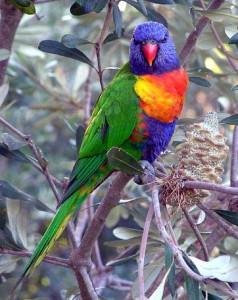
A rainbow lorikeet makes a bright, cheeky and loving pet for an owner who can handle some noise and mess. They truly live up to their name, with a violet blue head, a lime green collar, green back, wings and tail, and a red, orange and yellow chest. Hand raised birds are full of personality and love to play, wrestle toys and hang upside down.
In the wild, rainbow lorikeets live in rainforest, coastal forest, woodland and leafy suburbs right along the east coast. Over the last 20 years they’ve become a familiar sight in Sydney, Melbourne and Brisbane, and a population introduced to Perth is now well established. Closely related lorikeets in Indonesia and the Pacific are now treated as separate species.
The two things every new owner should know are noise and mess. Lorikeets have loud, shrill calls. Their nectar diet also means runny droppings that they can flick well beyond the cage. Plan for daily cleaning before you bring one home.
Essential Supplies for Rainbow Lorikeets
Housing
The largest cage you can fit and afford
Natural wood perches of different thicknesses
Separate dishes for dry food, wet food, fresh food and water
Newspaper or cage liners for the tray
Food
Birdsville Blends Lorikeet Dry (https://petsville.com.au/products/birdsville-blends-lorikeet-dry-1kg)
A wet nectar mix such as Vetafarm Forest Fusion Lori Diet (https://petsville.com.au/products/vetafarm-forest-fusion-lori-diet-450g)
Fresh fruit, vegetables and greens every day
Health
Vetafarm Multivet (https://petsville.com.au/products/vetafarm-multivet-50ml)
Vetafarm Calcivet (https://petsville.com.au/products/vetafarm-calcivet-50ml)
Vetafarm Wormout Gel (https://petsville.com.au/products/vetafarm-wormout-gel-50ml)
Avitrol Mite & Lice Spray (https://petsville.com.au/products/fidos-avitrol-bird-mite-and-lice-spray-125ml)
H3: Enrichment
Bainbridge Chew Me! Swing (https://petsville.com.au/products/bainbridge-chew-me-swing)
Natural Chew Toy (https://petsville.com.au/products/nat-island-natural-chew-toy-birds)
A shallow bird bath
What You May Consider
Passwell Lorikeet Treat Bar (https://petsville.com.au/products/passwell-delight-lorikeet-75g)
Dried paw paw (https://petsville.com.au/products/dried-fruit-paw-paw-papaya-150gm)
Oxymav B, kept on hand for emergencies (https://petsville.com.au/products/oxymav-b-100g)
Vetafarm Avicare cage disinfectant (https://petsville.com.au/products/vetafarm-avicare-rtu-500ml)

Housing
A rainbow lorikeet needs a cage big enough to move around, stretch and flap its wings, and play with toys, and the bigger the cage, the better off your bird will be. Lorikeets are busy, active birds, so a roomy cage also helps prevent boredom and weight gain. Choose one with a deep tray or seed guards to catch the mess.
Give your lorikeet perches of different sizes, because varied perches keep feet healthy. Natural wood is best. Swings are important too, as they keep legs strong and give your bird exercise.
Sydney seasonal tip: Wet nectar sours quickly in hot Sydney weather, sometimes within a few hours. In summer, offer small amounts of wet food and replace them often, or rely mainly on a dry lorikeet food that won’t spoil. In winter, keep the cage out of draughts. Draughts are one of the biggest causes of illness in pet birds.
Toys & Enrichment
Rainbow lorikeets need toys they can chew, wrestle and play with, plus daily enrichment beyond the toy box. Before taking over Birdsville, Ash worked as a zoo keeper, where varied daily enrichment for every animal was a major priority, and a pet lorikeet is no different. Parrots can’t thrive with only perches, food and water. Birds given enrichment are far less likely to develop self mutilation, feather plucking or excessive squawking. They also end up less fearful, friendlier, more relaxed and easier to train.
Good choices include rope, leather, wood and shredding toys, bells, balls, swings, ladders, cardboard, small boxes, wicker baskets, bird baths and food kabobs. Lorikeets especially love flowering branches. Safe flowers include bottlebrush, grevillea, eucalyptus, melaleuca, hibiscus, marigolds, dandelions, roses and violets, all of which give your bird real nectar and pollen to forage for. Collect only from unsprayed areas and wash everything well first. See our Natural Bird Toys page (https://birdsville.net.au/natural-toys/) for more ideas.
Our team’s tip: rotate toys regularly. A toy that’s been out of sight for a week or two feels like a brand new one.
Diet & Feeding
Rainbow lorikeets need a nectar replacement diet, not a seed mix. In the wild they feed on nectar, pollen, flowers and fruit, using a brush tipped tongue to collect them. A pet lorikeet needs a quality lorikeet food plus fresh fruit, vegetables and greens every day.
Lorikeets have a fast metabolism and their food passes through them quickly, so they graze all day. Keep lorikeet food available from morning to night, never just at set meal times.
Dry Lorikeet Food
Our top pick, and our biggest seller for lories and lorikeets, is Birdsville Blends Lorikeet Dry (https://petsville.com.au/products/birdsville-blends-lorikeet-dry-1kg). It’s a balanced dry alternative to nectar made for rainbow lorikeets and other nectar feeders, and lorikeets love it as an everyday food or a treat. Because it’s fed dry, it doesn’t sour like wet nectar, which makes it ideal for Sydney summers. We blend it fresh with a high turnover, so it never sits on a shelf, and buying from the people who make it means better value. Avoid many supermarket and chain store lorikeet foods, which are often low quality and can affect your bird’s health and vitality. With any dry food, plenty of fresh drinking water must always be available.
Wet Lorikeet Food
Wet mixes are made up with water, so your bird drinks less. Fresh drinking water is still a must. Good options include Vetafarm Forest Fusion Lori Diet (https://petsville.com.au/products/vetafarm-forest-fusion-lori-diet-450g), Wombaroo Lorikeet & Honeyeater Food (https://petsville.com.au/products/wombaroo-lorikeet-honeyeater-food-1-5kg) and Passwell Complete Lorikeet (https://petsville.com.au/products/passwell-complete-lorikeet-1kg). Throw out uneaten wet food within a few hours, before it sours.
Feeding Young Birds
Young rainbow lorikeets should have both wet and dry food, in separate dishes. Once they’re eating well, they can be weaned onto dry food only.
Fruits & Veggie Guide
Fruits
Apple, pear, paw paw, mango, melon, grapes, berries, banana and pomegranate.
Vegetables and Greens
Sweet potato, carrot, corn, broccoli, silverbeet and other dark leafy greens. Orange vegetables like carrot and sweet potato are rich in vitamin A, which helps protect lorikeets against fungal infections.
Treats
Fresh flowers from the safe list above, dried paw paw (https://petsville.com.au/products/dried-fruit-paw-paw-papaya-150gm) and the Passwell Lorikeet Treat Bar (https://petsville.com.au/products/passwell-delight-lorikeet-75g).
Avoid Entirely
Avocado, onion, chocolate, caffeine and alcohol.

Providing Water to Your Rainbow Lorikeet
Fresh, clean water must be available to your lorikeet at all times, especially if it eats dry food. Change it daily and scrub the dish, because sticky nectar quickly turns water dirty. Lorikeets love to bathe, so offer a shallow bath a few times a week, and every day in hot weather.
Calcium and Vitamins for Rainbow Lorikeets
Rainbow lorikeets benefit from a vitamin supplement in their water every two to three days, to cover nutrients that are often missing from captive diets. Vetafarm Multivet (https://petsville.com.au/products/vetafarm-multivet-50ml) is an easy option. They also need a calcium source. Add Calcivet (https://petsville.com.au/products/vetafarm-calcivet-50ml) to the water, and offer dark leafy greens daily.
Behaviour & Handling
Let a new rainbow lorikeet settle for a day or two before handling it. After that, handle it in a quiet, relaxed setting. Sitting with your bird while you watch TV or read is perfect. Babies need their rest, so don’t overstress your bird in the first few weeks. Adult lorikeets love noise and attention, but young birds in a new home need calm time to eat, drink and rest.
Watch children around a new bird. Overexcited kids grabbing, chasing and over loving a baby lorikeet can stress it badly. Stressed birds are much more likely to get sick.
Training Your Rainbow Lorikeet
Training is what makes a hand raised lorikeet a well behaved companion. Keep three rules in mind:
When your bird does something good, reward it.
When your bird does something you don’t want, ignore it.
Never punish your bird.
Start with “step up”. Hold your bird on one hand, place your other hand gently against its chest and say “step up” while applying slight pressure. Your lorikeet will lift one foot. Lift your hand slightly and the other foot will follow. Reward straight away with a favourite treat, such as a piece of fruit. As your bird improves, ask for a few step ups before each reward, then switch from food to praise.
Keep sessions short and frequent. For more, see our How to Train Your Parrot page (https://birdsville.net.au/pet-bird-advice-and-training/bird-training-clicker-training-parrot-body-language/).

How to Choose a Healthy Rainbow Lorikeet
Never buy a rainbow lorikeet without having a good look at it first. Here’s what to check.
Eyes: bright and clear, with no discharge, swelling, redness or squinting.
Body condition: feel the keel bone in the middle of the chest, where the flight muscles attach. A sick bird usually loses weight first, and its chest muscle feels thin. Birds have a very high metabolism and can lose weight fast, so check this regularly at home too.
Mouth and beak: clean, with no lesions, wetness or build up inside, and a beak that isn’t overgrown.
Nostrils: open and free of discharge.
Feathers: fully feathered and smooth. Young lorikeets often have ragged body and tail feathers from walking through wet food and rubbing on wire, which is normal.
Wing clipping: if the wings are clipped, both should be done evenly. A bird clipped on one side may still fly, but lopsided, and can hurt itself landing.
Weaning: unless you have hand raising experience, only buy a fully weaned bird that’s eating on its own. Hand feeding mistakes can cause permanent harm or death, and your bond with a weaned bird won’t suffer at all.
Appetite: choose a bird with a big appetite. A keen eater is usually a healthy one.
Vent: clean, with no staining or droppings stuck to the feathers.
Legs and feet: clean and strong.
Enclosure: the birds should be kept somewhere clean and hygienic.
Behaviour: active and alert. A sluggish or weak bird may be ill or too young to feed itself.
Common Health Issues in Rainbow Lorikeets
Yeast Infections
The high sugar content of a nectar diet can lead to yeast (candida) infections. The main sign is a lorikeet that’s suddenly lethargic and not its usual energetic self. Keep food fresh, clean dishes daily, and see an avian vet if your bird isn’t acting normally.
Fungal Infections
Fungal infections are common in lorikeets and usually come from poor housing or contaminated food. A lack of vitamin A makes birds more vulnerable. Keep the cage clean, replace wet food before it spoils, give fresh clean water, and feed vitamin A rich foods like carrot and sweet potato.
Bacterial Infections
Lorikeets can pick up bacteria in the home from floors, children and other animals, and stress makes them more vulnerable. If your bird is quieter than normal and sits fluffed up, keep it warm straight away with a heat lamp or a heater near the cage, and contact an avian vet. Oxymav B (https://petsville.com.au/products/oxymav-b-100g), a broad spectrum antibiotic that goes in the water, is worth having on hand, but use it as your vet directs.
Psittacine Beak and Feather Disease (PBFD)
PBFD is a virus that can infect all parrots and spreads through feather dust and droppings. Many young birds with PBFD die before they leave the nest, and others lose feathers from a young age. In our experience, many lorikeets build up an immune response over time, regrow their feathers and go on to live long, healthy lives, though they likely remain carriers. Birds with weak immune systems can become very ill. There’s no vaccine, so a healthy diet, a clean home and low stress give your bird the best chance. Any lorikeet with feather loss should be tested by an avian vet.
Stress
When Ash worked as a zoo keeper, reducing stress was one of the most important parts of the job, because stress is one of the biggest problems for any animal in captivity. Giving your lorikeet the right environment, routine and quiet time keeps it relaxed and better able to fight off the infections above.
Obesity
Obesity can shorten a lorikeet’s life, and the RSPCA notes it can lead to diabetes (https://kb.rspca.org.au/knowledge-base/how-should-i-care-for-my-lorikeet/). A large cage, swings, varied perches and daily exercise out of the cage all help your bird burn calories. If your lorikeet is gaining weight, ask our team about lower fat lorikeet foods.
Injuries
Broken legs, wings, beaks and feet usually happen when a bird flies into a window, mirror or ceiling fan. When your lorikeet is out of its cage, close the windows, turn off fans and supervise it. Take any injured bird to a vet immediately. For more conditions, see Common Bird Illnesses (https://birdsville.net.au/common-bird-illnesses/).
Parasite Control for Rainbow Lorikeets
Worm your rainbow lorikeet every 6 months. A recently weaned bird has delicate gut bacteria still developing, so wait a few weeks to two months after bringing it home before its first worming. Our team will tell you when it’s due. Vetafarm Wormout Gel (https://petsville.com.au/products/vetafarm-wormout-gel-50ml) goes in the drinking water, with the dose on the label.
For lice and mites, spray your bird, the whole cage, perches, nest box and toys with Avitrol Mite & Lice Spray (https://petsville.com.au/products/fidos-avitrol-bird-mite-and-lice-spray-125ml). Remove food and water first, and avoid the eyes and mouth.
Keep any new bird in a separate cage for 4 to 6 weeks before introducing it to your other birds.
Health, Hygiene & Safety
Lorikeets are messier than most parrots, so cleaning is a daily job.
Daily: change water, replace wet food and fresh food, wash food dishes, and change the tray liner.
Weekly: scrub perches and toys, and wipe down the cage.
Monthly: fully disinfect the cage with Vetafarm Avicare (https://petsville.com.au/products/vetafarm-avicare-rtu-500ml).
The RSPCA recommends a vet health check at least once a year, because birds are experts at hiding illness.
Toxic & Household Dangers
Dogs and cats: pets that aren’t well socialised can be a real danger to a bird. Always supervise your lorikeet around dogs and cats, introduce them slowly, and take extra care with hunting breeds.
Ceiling fans: always turn them off before letting your bird out.
Windows, doors and mirrors: birds often fly into them, especially in a new home.
Poisons: zinc, copper, bleach, oven cleaner, glue, nail polish remover, paint and insecticides. Fumes from non stick cookware and aerosols are dangerous too.
Open water: a bird can drown in a sink, a bucket or even a coffee mug.
Electrical cords: lorikeets will chew them.
Draughts: keep your bird in a draught free spot.
Unsafe foods: see the Avoid Entirely list above.
Sexing Rainbow Lorikeets
Male and female rainbow lorikeets look identical, so the only reliable way to sex one is a DNA test through an avian vet. Chest colour varies from bird to bird and isn’t a sign of sex. Juveniles are easy to tell from adults, though. They have duller feathers, brown eyes and a dark beak, and it can take up to a year for a young bird to fully colour up. Rainbow lorikeets are also bred in a range of colour mutations.
Record Keeping
Keep a simple diary for your lorikeet: worming and mite treatment dates, vet visits, weight checks and any changes in droppings, feathers or behaviour. It helps you spot problems early and gives your vet a useful history.
Holiday Care
A lorikeet needs fresh food and water every day, and wet food more often in summer. Arrange for someone to visit at least once daily while you’re away. For longer trips, see Bird Boarding in Sydney (https://birdsville.net.au/parrot-bird-boarding-sydney/).
Transportation
Always move a lorikeet in a secure, ventilated carrier. Keep trips short and the car at a comfortable temperature, and never leave your bird in a parked car. See our Carry Cages page (https://birdsville.net.au/carry-cages/) for options.
Compatibility with Other Birds
Introduce a new rainbow lorikeet slowly. After quarantine, place the cages where the birds can see and hear each other, and give them time to get used to each other before they share space. Rainbow lorikeets can be bossy and territorial, so never house them with smaller birds, and watch closely when mixing them with other species.

Rainbow Lorikeet Frequently Asked Questions
Do rainbow lorikeets make good pets?
Yes, for an owner who can handle noise and mess. Hand raised rainbow lorikeets are playful, affectionate and full of personality, and many become very tame. They need a nectar based diet, a large cage, daily time out and plenty of toys, and their liquid droppings mean more cleaning than a seed eating parrot.
Can rainbow lorikeets talk?
Yes, many do. Rainbow lorikeets can learn a handful of words and short phrases, though their voice is less clear than the bigger talking parrots. They also copy whistles and household sounds. Talking with your bird every day and rewarding every attempt gives it the best chance to learn.
How long do rainbow lorikeets live?
Pet rainbow lorikeets commonly live 15 to 25 years with good care, and some live longer. Published figures vary widely, from about 16 to 30 years. A fresh, balanced lorikeet diet, a clean cage, regular worming and yearly vet checks all help your bird reach the top of that range.
What do rainbow lorikeets eat?
Rainbow lorikeets are nectar feeders, so they need a lorikeet diet, not a seed mix. Feed a quality dry lorikeet food such as Birdsville Blends Lorikeet Dry, with or without a wet nectar mix, plus fresh fruit, vegetables and greens every day. Always provide fresh drinking water, especially with dry food.
Are rainbow lorikeets messy and noisy?
Yes, on both counts. A nectar diet means runny droppings that lorikeets can flick well beyond the cage, so plan for daily cleaning. Their calls are loud and shrill, especially in the morning and evening. Many owners find their colour and personality well worth it, but they suit houses better than apartments.
How can you tell if a rainbow lorikeet is male or female?
Not by looking. Male and female rainbow lorikeets look the same, and chest colour varies from bird to bird regardless of sex. The only reliable way to tell is a DNA test by an avian vet, using a feather or blood sample. Juveniles have duller colours, darker beaks and brown eyes.
Recommended Vets and Links
SASH (Small Animal Specialist Hospital), 02 8913 4000, 5/476 Gardeners Rd, Alexandria NSW 2015, sashvets.com (24/7 emergency)
The Wild Vet, 1300 945 3838, 22A Bridge Road, Glebe, thewildvet.com.au
SERV, 02 9436 4884, 57-63 Herbert St, Artarmon, exoticsvet.com.au
Southern Cross, 02 9516 0234, 60 Princes Hwy, St Peters, southerncrossvet.com.au
Carlingford Animal Hospital, 02 9871 6036, 772 Pennant Hills Road, Carlingford, birdhealth.com.au
The Unusual Pet Vets, 02 9319 6111, 995 Bourke Street, Waterloo NSW 2017, unusualpetvets.com.au
Vetafarm, vetafarm.com.au
RSPCA lorikeet care: https://kb.rspca.org.au/knowledge-base/how-should-i-care-for-my-lorikeet/
Related Birdsville pages: Black Cap Lory (https://birdsville.net.au/animals-for-sale/birds-for-sale/lori-and-lorikeet/black-cap-lory/), Feather Plucking (https://birdsville.net.au/pet-bird-advice-and-training/feather-plucking/), Hand Raising Baby Birds (https://birdsville.net.au/hand-raising-baby-birds/), Birdsville Blends (https://birdsville.net.au/birdsville-blends/).
Visit Birdsville for Rainbow Lorikeet Supplies
Lorikeet food, cages, toys and everything else your rainbow lorikeet needs are available in-store at Birdsville, 684 Botany Road, Alexandria NSW 2015, servicing the Eastern Suburbs and Inner South Sydney. Call us to ask about hand raised rainbow lorikeets. Visit us or call (02) 9669 1766. Follow us on Facebook (https://www.facebook.com/BirdsvilleRosebery/), Instagram (https://www.instagram.com/petsvillesydney/) and TikTok (https://www.tiktok.com/@birdsvillepets) for live updates.
About Birdsville
Birdsville has been trading in Sydney since 1985, and we believe we’re now the oldest bricks and mortar bird shop still open in Australia. Owner Ash brings experience from vet clinics and from zoo keeping at the Rainforest Habitat in Port Douglas, now Wildlife Habitat. We’re a small business that does things in a big way. Nobody tells us how to run things, so we keep our products the best of the best.
Sources
Size, weight and range: World Parrot Trust (parrots.org) and the Australian Bird Study Association
Vet checks and obesity risks: RSPCA Knowledgebase
Diet, housing, enrichment, worming, health and handling advice: Ash and the Birdsville team
Product details: Petsville product listings